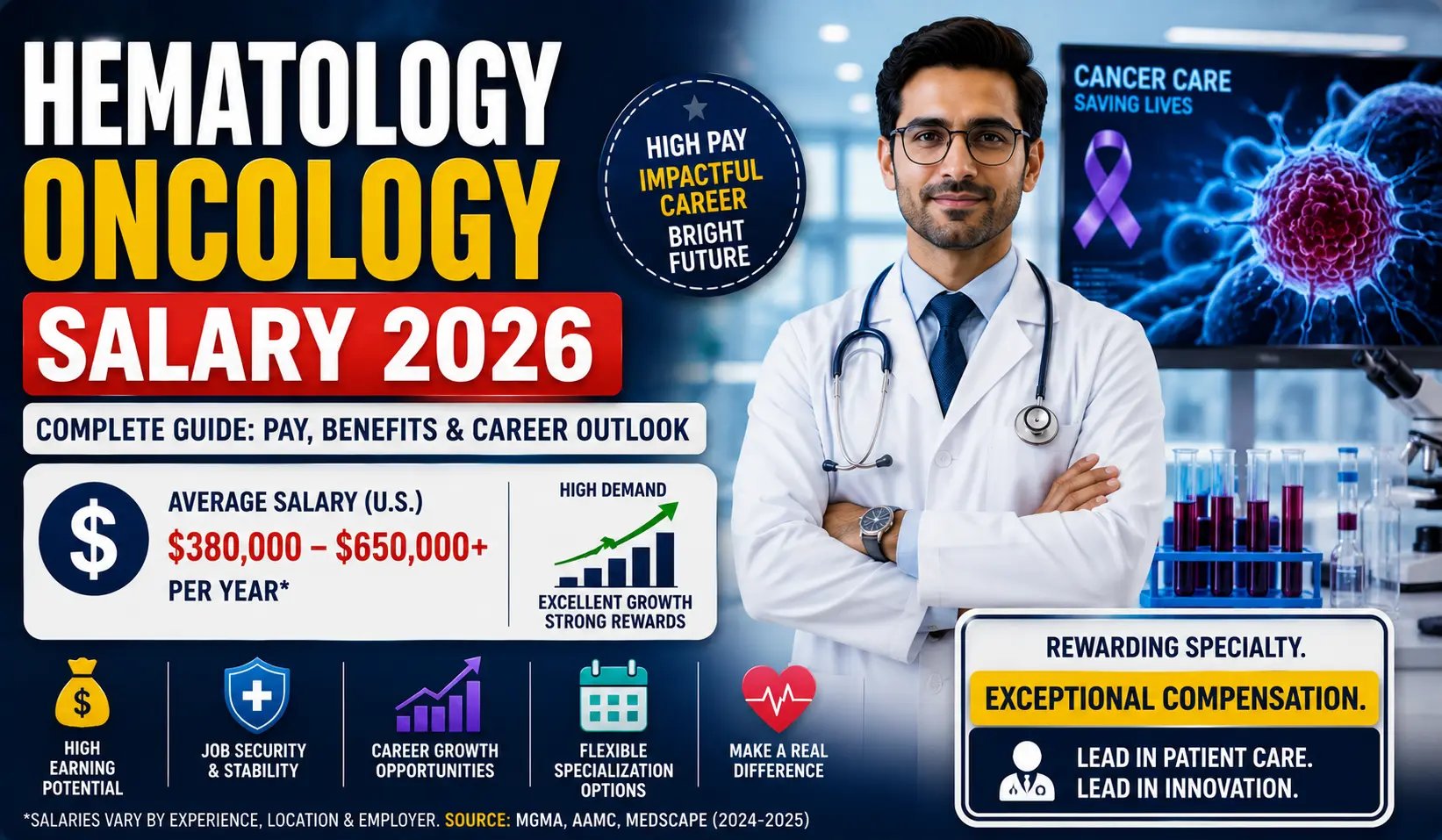
Hematology Oncology Salary in the United States (2026)
Hematology-oncology physicians diagnose and treat blood disorders, leukemia, lymphoma, and cancer. It is one of the most specialized fields in internal medicine and requires years of additional fellowship training after residency.
In the United States, these specialists work across multiple sectors. Common employers include private cancer centers, physician-owned practices, academic medical centers, state university hospitals, and federal healthcare systems such as the Department of Veterans Affairs (VA).
Compensation can vary dramatically depending on employer type, productivity incentives, geographic location, and patient volume. This guide explains current earnings, benefits, taxes, career progression, and what prospective physicians should realistically expect in 2026.
Who Is a Hematology-Oncology Physician?
A hematology-oncology physician is a doctor who specializes in:
- Diagnosing blood disorders
- Treating cancers and tumors
- Managing chemotherapy and immunotherapy
- Monitoring long-term cancer survivors
- Participating in clinical research and clinical trials
Most physicians in this specialty complete:
- Bachelor’s degree
- Medical school (MD or DO)
- Internal Medicine residency
- Hematology-Oncology fellowship
The role exists across:
- Private-sector oncology groups
- Academic and state-funded teaching hospitals
- Federal healthcare systems (primarily the VA)
Salary Breakdown by Sector
Private-Sector Hematology Oncology Compensation
Private practice and large healthcare systems generally offer the highest earning potential. Compensation often includes productivity bonuses tied to work RVUs, collections, or patient volume.
According to Doximity’s 2025 Physician Compensation Report, average oncology compensation exceeded $500,000 annually, while hematology specialists averaged over $420,000. Combined hematology-oncology physicians often fall within this range depending on practice mix.
Private Sector Salary Structure
| Pay Component | Typical Annual Amount (Gross) | Source |
| Base Salary | $350,000–$550,000 | Doximity Physician Compensation Reports 2024–2025 |
| Productivity Bonus | $20,000–$150,000+ | MGMA compensation trends |
| Signing Bonus | $10,000–$100,000+ (varies) | MGMA recruitment trends |
| Quality Incentives | Employer-specific | MGMA compensation models |
| Total Compensation Range | Approximately $400,000–$700,000+ | Industry compensation surveys |
Figures represent gross annual compensation before taxes and deductions.
Federal Government (VA) Salary Structure
Federal hematology-oncology physicians primarily work within the Veterans Health Administration (VHA).
Unlike most federal employees, physicians are generally paid under Title 38 physician pay authority, not the standard GS pay scale. Pay includes base pay, market pay, and specialty-specific adjustments. Hematology-Oncology is listed among VA clinical specialties eligible for physician pay schedules.
Federal Government Salary Structure
| Pay Component | Typical Range |
| Base Pay | Varies by physician grade and longevity |
| Market Pay | Determined locally by recruitment market |
| Specialty Adjustment | Included under Title 38 physician pay |
| Total Annual Compensation | Commonly $250,000–$400,000+ depending on location and experience |
| Retirement | FERS + TSP participation |
Source: U.S. Department of Veterans Affairs Title 38 Physician Pay System.
Because VA physician compensation is locality-adjusted and negotiated within approved ranges, exact earnings vary significantly by facility.
State and Academic Medical Center Compensation
Many hematology-oncology physicians work at public university hospitals and state-funded academic medical centers.
These positions often offer lower compensation than private practice but provide greater access to research, teaching opportunities, and clinical trials.
State/Academic Sector Salary Structure
| Pay Component | Typical Annual Amount |
| Academic Base Salary | $250,000–$450,000 |
| Research Stipends | Employer-dependent |
| Clinical Incentives | Often available |
| Leadership Supplements | Department-specific |
| Total Compensation | $300,000–$550,000+ |
Range derived from public university physician salary disclosures and academic recruiting benchmarks. Individual institutions vary considerably.
Pay Variation by Location
Location remains one of the biggest drivers of physician compensation.
Typical Geographic Differences
| Region | Relative Compensation Trend |
| Midwest | Often above national average |
| Southeast | Frequently offers recruitment incentives |
| Northeast | Higher cost of living, mixed compensation |
| California | High compensation but high taxes and living costs |
| Rural Areas | Often provide significant recruitment bonuses |
According to Doximity metropolitan compensation data, physician earnings vary considerably among cities and regions.
Compensation Comparison by Career Stage
| Career Stage | Typical Gross Annual Compensation |
| Fellowship Graduate | $275,000–$450,000 |
| Early Career (1–5 years) | $350,000–$550,000 |
| Mid-Career (5–15 years) | $450,000–$700,000 |
| Senior Physician | $550,000–$900,000+ |
| Practice Partner / Medical Director | $700,000–$1M+ (highly variable) |
Ranges represent industry estimates based on physician compensation surveys and recruitment data.
Career Progression and Advancement Path
Typical Pathway
| Stage | Approximate Timeline |
| Medical School | 4 years |
| Internal Medicine Residency | 3 years |
| Hematology-Oncology Fellowship | 3 years |
| Staff Physician | Entry level |
| Senior Physician | Typically 5–10 years |
| Medical Director / Division Chief | Varies by employer |
| Cancer Center Leadership | Experience-dependent |
Promotion timelines vary widely between academic institutions, hospital systems, and private groups.
Benefits and Perks
Private Practice
- Health insurance
- Dental and vision coverage
- 401(k) matching
- Productivity bonuses
- CME allowance
- Malpractice insurance
- Signing bonuses
Federal VA
- Federal Employees Health Benefits (FEHB)
- FERS pension
- Thrift Savings Plan (TSP)
- Federal leave programs
- Possible student-loan assistance
- Predictable retirement benefits
Academic Medical Centers
- Faculty appointments
- Research funding opportunities
- Tuition assistance
- CME funding
- Retirement plans
- Access to clinical trials
Deductions and Take-Home Considerations
Physician compensation is reported as gross pay, not take-home pay.
Federal Income Tax
Federal income tax uses progressive IRS tax brackets that are adjusted periodically for inflation. Higher-earning specialists often fall into upper marginal tax brackets. IRS rules apply nationwide.
FICA Taxes
Employees generally pay:
| Tax | Rate |
| Social Security | 6.2% (up to annual wage base) |
| Medicare | 1.45% |
| Additional Medicare Tax | Applies above IRS income thresholds |
Source: Internal Revenue Service (IRS).
State Income Tax
State tax treatment varies significantly.
Examples:
| State | Income Tax Situation |
| Texas | No state wage income tax |
| Florida | No state wage income tax |
| California | Progressive state income tax |
| New York | Progressive state income tax |
Several states do not levy state income tax on wages, while others impose substantial tax burdens.
Local Taxes
Certain locations, including New York City and Philadelphia, impose local income taxes in addition to state and federal obligations.
Retirement Contributions
Private Sector
- 401(k)
- Roth options
- Employer matching
Federal Sector
- FERS contributions
- Thrift Savings Plan
Academic Sector
- 403(b)
- 457(b) plans (where offered)
Actual take-home earnings can differ by tens of thousands of dollars annually depending on state and retirement elections.
How to Enter This Field
Education Requirements
- Bachelor’s degree
- Medical school (MD or DO)
- Internal Medicine residency
- Hematology-Oncology fellowship
- Board certification
Private Sector Hiring
- Direct physician recruitment
- Healthcare recruiters
- Hospital employment contracts
- Partnership-track positions
Federal Government Hiring
Most VA positions are posted through:
Applicants must meet federal credentialing requirements.
Academic Hiring
Academic centers typically evaluate:
- Clinical experience
- Research publications
- Fellowship training
- Teaching experience
Which Sector Should You Choose?
There is no universally best option.
Private practice usually offers the highest income potential and faster compensation growth. The trade-off is greater productivity pressure and business-related responsibilities.
Federal VA positions generally provide stronger retirement benefits and more predictable schedules. Compensation may be lower than top private practices, but work-life balance can be more attractive for some physicians.
Academic medicine appeals to those interested in research, teaching, and clinical innovation. Earnings are often lower than high-performing private groups, but academic careers provide opportunities that private practice may not.
Frequently Asked Questions
Is hematology-oncology one of the highest-paid medical specialties?
Yes. Compensation typically places the specialty among the higher-paying physician fields, though surgical specialties often earn more.
Can a hematology-oncology physician earn more than $700,000 per year?
Yes. Experienced physicians in productive private practices, partnership roles, or leadership positions may exceed that level. Individual results vary substantially.
Does the VA use the GS pay scale for hematology-oncology physicians?
Generally no. Most VA physicians are compensated under Title 38 physician pay authority rather than standard GS schedules.
Which states tend to offer the highest recruitment incentives?
Rural regions and physician-shortage areas frequently provide larger signing bonuses and relocation assistance, regardless of state.
How long does it take to become a hematology-oncology physician?
Typically about 13–15 years after high school, including undergraduate education, medical school, residency, and fellowship.
Is academic medicine worth the lower compensation?
For physicians interested in research, teaching, and clinical trials, academic centers can provide career opportunities that may outweigh purely financial considerations.
Conclusion
Hematology-oncology remains one of the most financially rewarding physician specialties in the United States. Private practice generally delivers the highest earning potential, while VA and academic positions offer different advantages in stability, benefits, research opportunities, and work-life balance. Evaluating total compensation—not just salary—is the best way to compare opportunities in 2026.