Occupational Therapist Salary 2026: Hourly Pay, State-Wise Wages & Job Outlook
How much do occupational therapists make in 2026? The short answer: a median of $100,330 per year, or about $48.24 per hour, according to the latest U.S. Bureau of Labor Statistics (BLS) data from May 2025. But that single number hides a wide spread. Where you work, what setting you practice in, and how long you have been licensed can move your pay by tens of thousands of dollars a year.
Occupational Therapist Salary: Quick Answer
If you are scanning for the numbers fast, here is the 2026 snapshot of occupational therapist salary in the United States:
- Median annual salary: $100,330 (BLS, May 2025 data)
- Median hourly rate: $48.24 per hour
- Approximate monthly equivalent: about $8,361 (annual figure divided by 12, before taxes)
- Lowest 10 percent: below $71,690 per year
- Highest 10 percent: above $131,950 per year
- Job outlook: 15 percent employment growth projected from 2025 to 2035, much faster than average
Salary varies by employer, experience, location, qualifications, and compensation structure. The rest of this guide breaks down what OTs earn by state, work setting, and experience level so you can judge where you stand or where the field could take you.
Average Occupational Therapist Pay in 2026
The BLS publishes official wage data for occupational therapists as part of its Occupational Outlook Handbook, and the most current figures (May 2025, the dataset most 2026 guides draw on) put the median annual wage at $100,330. That is the middle of the profession: half of all OTs earn more, half earn less.
To put that in perspective, the federal data also shows a clear earnings ladder. The bottom tenth of earners bring in less than $71,690 a year, while the top tenth clear more than $131,950. Most working OTs land somewhere between those two points, and the section that follows explains why the range is so wide.
Employee-reported figures from job portals skew slightly lower than the federal numbers. ZipRecruiter, which aggregates employer postings and third-party data, reported a national average of about $94,375 for occupational therapist positions in its September 2026 hourly data. The gap is normal: posting averages and the official national wage survey measure slightly different things, and actual offers also reflect local market conditions.
Occupational Therapist Hourly Pay
Many OTs are paid by the hour rather than on salary, especially in home health, contract roles, and PRN (as-needed) work. The national median hourly rate of $48.24 translates to the $100,330 annual figure for a standard full-time schedule.
Industry-reported hourly bands, which reflect employer postings rather than the federal survey, typically look like this:
| Experience level | Typical hourly range | Approximate annual equivalent |
|---|---|---|
| Entry-level (0-2 years) | $35-$42/hour | $72,800-$87,400 |
| Mid-career (3-7 years) | $43-$52/hour | $89,400-$108,200 |
| Experienced (8+ years) | $53-$65/hour | $110,200-$135,200 |
| Specialized / contract / travel | $65-$80+/hour | $135,200-$166,400+ |
Source: employer-posting and job-portal estimates; annual equivalents are approximate, assuming a full-time schedule. Actual take-home pay depends on benefits, overtime, and tax situation.
Hourly rates run highest for travel therapists, PRN shifts, and contract assignments, where employers pay a premium for flexibility. For OTs considering whether hourly or salaried roles pay better, the honest answer is that it depends on the setting and how many hours you want to work.
Occupational Therapist Salary by State
Geography is one of the biggest levers on OT pay. The table below uses the latest BLS state-level figures compiled in a 2026 salary guide, shown as median annual and median hourly pay for full-time occupational therapists.
| State | Median annual pay | Median hourly pay |
|---|---|---|
| California | $124,510 | $59.86 |
| Oregon | $112,310 | $54.00 |
| Nevada | $110,520 | $53.13 |
| District of Columbia | $109,170 | $52.49 |
| Washington | $107,670 | $51.77 |
| Maryland | $106,980 | $51.43 |
| Colorado | $106,720 | $51.31 |
| Texas | $106,140 | $51.03 |
| Arkansas | $106,360 | $51.14 |
| Oklahoma | $104,300 | $50.14 |
| Florida | $99,360 | $47.77 |
| Ohio | $99,390 | $47.78 |
| Illinois | $99,700 | $47.93 |
| New York | $96,390 | $46.34 |
| Minnesota | $93,050 | $44.74 |
| Wyoming | $86,170 | $41.43 |
| Maine | $84,310 | $40.53 |
| South Dakota | $85,050 | $40.89 |
| North Dakota | $83,200 | $40.00 |
Source: BLS Occupational Employment and Wage Statistics, compiled in the TagMed 2026 OT salary guide. Figures are median full-time annualized wages.
California leads the country by a wide margin, driven by its high cost of living, large healthcare market, and strong demand in metro areas like San Jose. The BLS mean-wage tables tell a similar story: Nevada ($109,010 mean) and California ($105,760 mean) top the official top-paying-states list, followed by New Jersey, Texas, and New Mexico.
One important caveat: a bigger paycheck does not always mean a better lifestyle. Texas and Nevada pay OTs well while carrying a much lower cost of living than California or New Jersey, so the same salary can stretch noticeably further. Relocating from a lower-paying state to a top-paying one can add $30,000-$50,000 to annual earnings, but the real win comes when wages rise faster than living costs.
Occupational Therapist Salary by Work Setting
Where you practice matters almost as much as where you live. The BLS breaks OT wages down by industry, and the pattern is consistent: home health and skilled nursing facilities pay more than outpatient clinics and schools.
| Work setting | Hourly mean wage | Annual mean wage |
|---|---|---|
| Home health care services | $50.82 | $105,700 |
| Outpatient care centers | $49.44 | $102,840 |
| Nursing care facilities (skilled nursing) | $47.12 | $98,000 |
| Specialty hospitals | $47.62 | $99,040 |
| General medical and surgical hospitals | $45.85 | $95,370 |
| Offices of other health practitioners | $43.63 | $90,750 |
| Elementary and secondary schools | $39.94 | $83,070 |
| Educational support services | $38.65 | $80,400 |
Source: BLS Occupational Employment and Wage Statistics, May 2022 (the most recent industry-level release for this occupation). Industry-reported estimates for 2026 generally run higher, particularly in home health and skilled nursing.
The school-based number surprises many people: OTs working in elementary and secondary schools earn noticeably less than their peers in home health or nursing facilities. School schedules, summers off, and pension benefits make these roles attractive for a different reason, but if maximizing income is the goal, home health and skilled nursing consistently come out on top.
Entry-Level vs Experienced Occupational Therapist Salary
New graduates should expect to start below the national median. Employer-posting data for 2026 puts entry-level OTs (0-2 years) in the $65,000-$78,000 range, roughly $31-$37 an hour on a full-time schedule. In high-cost metros the starting number runs higher; in rural or school-based roles it can sit lower.
The pay curve steepens once you pass the three-year mark. Job-hopping at that stage can deliver raises of 10-18 percent, and mid-career OTs (6-10 years) commonly earn $93,000-$108,000. Senior clinicians with 11-20 years of experience typically land between $109,000 and $125,000, while late-career experts in lucrative settings or supervisory roles can push past $130,000, matching the top tenth of the BLS distribution.
Two things move the needle faster than simply accumulating years. The first is specialization: hand therapy certification, neurological rehabilitation, and pediatric specialty credentials are the clearest documented routes to above-market pay. The second is the setting switch described above, where a senior OT moving from a school district into home health can see an immediate and substantial raise.
If you are weighing OT against other licensed healthcare careers, our LPN salary guide breaks down what licensed practical nurses earn across the same states, and the phlebotomist salary guide covers another fast-entry medical role for comparison.
Factors That Affect Occupational Therapist Salary
Understanding what drives pay differences helps you negotiate and plan. The main factors are:
Experience and seniority. Pay rises with years in practice, but the curve flattens after roughly year ten unless you add specialties or move into leadership.
Location. State medians range from about $83,000 in North Dakota to nearly $125,000 in California. Even within a state, major metros typically pay more than rural areas, though remote and underserved regions sometimes offer incentives or student loan forgiveness.
Work setting. Home health and skilled nursing pay the most; schools pay the least among major settings. Outpatient clinics sit in the middle.
Specialty certifications. Hand therapy (CHT), lymphedema, neurological, and pediatric specialty credentials command premiums because demand for them outpaces supply.
Employment type. Full-time staff roles offer benefits and stability. Contract, PRN, and travel assignments pay higher hourly rates but usually without the same benefits package, so compare total compensation, not just the hourly number.
Employer and market demand. Areas with OT shortages pay more. The national 15 percent growth projection means demand is strong, but local labor markets still set the actual offer.
What Does an Occupational Therapist Do?
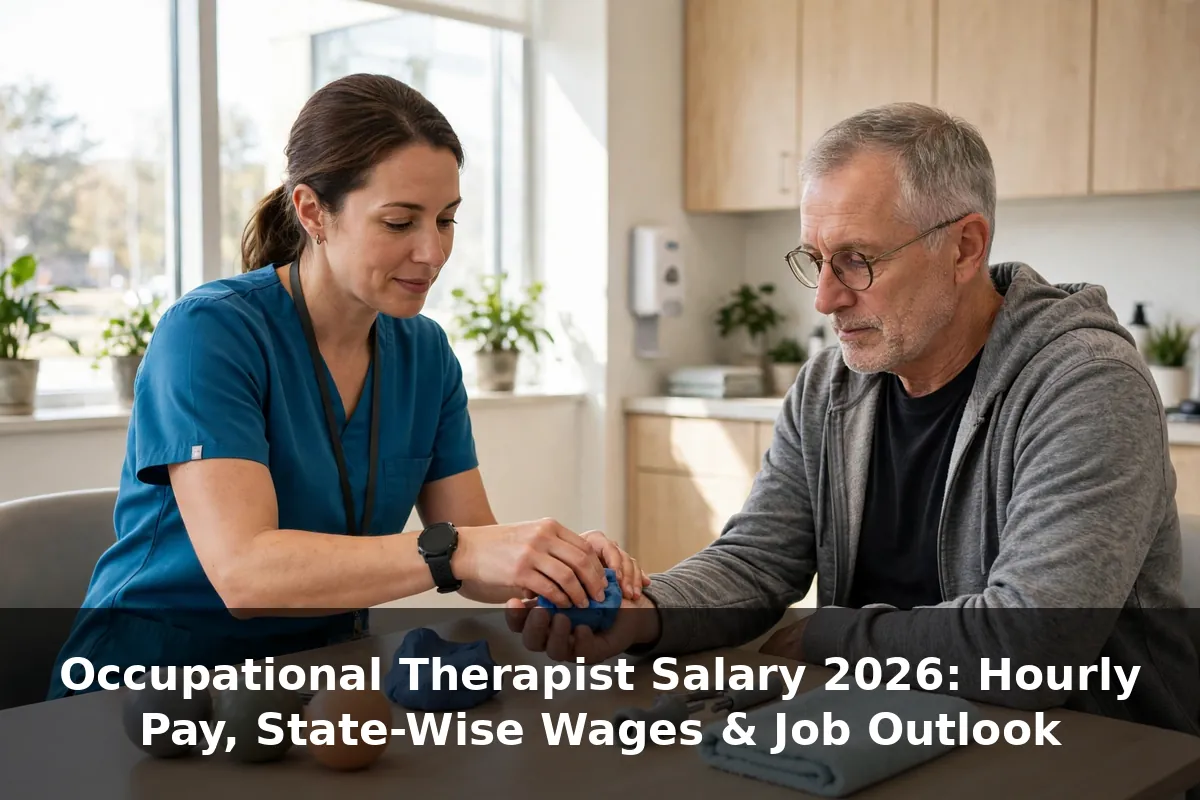
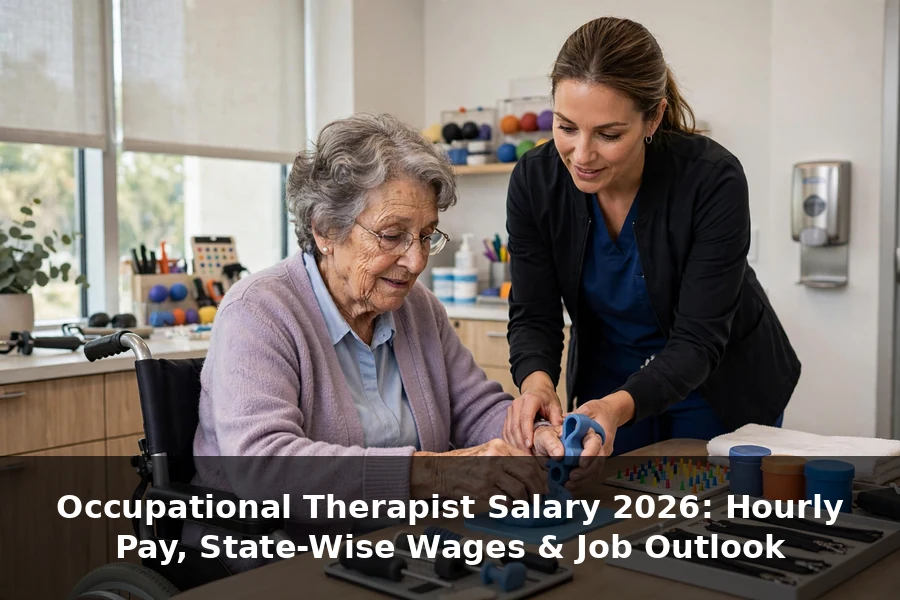
Occupational therapists help people with injuries, illnesses, or disabilities regain the skills they need for daily living and work. A typical day can include assessing a patient’s physical and cognitive abilities, developing treatment plans, guiding rehabilitation exercises, recommending adaptive equipment, and documenting progress for insurance and care teams.
OTs work in hospitals, outpatient clinics, schools, nursing facilities, home health, and private practice. The work is physically active: therapists stand for long stretches and often need to lift or move clients. They collaborate closely with physicians, physical therapists, speech-language pathologists, and nursing staff, as well as with patients’ families. For a look at another hands-on clinical role, see our CNA salary guide, which covers certified nursing assistants who often work alongside OTs in rehab settings.
Education and Licensing Requirements
Becoming an occupational therapist in the United States requires a clear set of steps:
- Earn an accredited graduate degree. OTs typically need a master’s degree in occupational therapy; entry-level doctoral programs (OTD) are also available and increasingly common.
- Pass the NBCOT exam. The National Board for Certification in Occupational Therapy examination is the national credential.
- Get a state license. All states require occupational therapists to be licensed, and each state sets its own application and renewal requirements.
- Keep credentials current. States require continuing education for license renewal, and some roles ask for specialty certifications on top of the base license.
A few states participate in the Occupational Therapy Licensure Compact (OT Compact), which can simplify practicing across member states without obtaining a separate license in each one. Check the licensing board in the state where you plan to practice, since rules on supervision, documentation, and field practice vary.
Job Outlook for Occupational Therapists
The employment picture is strong. The BLS reported 169,600 occupational therapist jobs in 2025 and projects employment to grow 15 percent between 2025 and 2035, much faster than the average for all occupations. That growth translates to roughly 25,200 new positions, plus about 10,000 openings a year on average as workers retire or change occupations.
Demand is driven by demographics: an aging population needs more rehabilitation services, and OTs also support children with developmental conditions and adults recovering from injuries and illnesses. Growth is expected across settings, but home health and outpatient care are projected to expand particularly quickly.
Frequently Asked Questions
What is the average occupational therapist salary per month?
Using the BLS median of $100,330 per year, the approximate monthly equivalent is about $8,361 before taxes and deductions. This is a straight division of the annual figure, not a guaranteed take-home amount.
What is the starting salary for an occupational therapist?
Entry-level OTs with 0-2 years of experience typically earn $65,000-$78,000 a year, or about $31-$37 an hour, according to employer-posting data for 2026. Offers vary by state, setting, and local demand.
What is the highest-paying state for occupational therapists?
California pays the most, with a median of $124,510 per year ($59.86/hour). Oregon, Nevada, Washington, and Maryland round out the top tier, all above $106,000 in median annual pay.
Do occupational therapists make $100,000 a year?
Yes. The national median is $100,330, so roughly half of all OTs earn six figures. Reaching that level is most common in home health, skilled nursing, and higher-paying states, and for OTs with several years of experience.
What setting pays occupational therapists the most?
Home health care services top the BLS industry table at a $105,700 annual mean wage (May 2022 data), followed by outpatient care centers and skilled nursing facilities. School-based roles pay the least among major settings but offer different lifestyle benefits.
How long does it take to become an occupational therapist?
Expect about 6-7 years after high school: a bachelor’s degree (4 years) plus an accredited master’s or doctoral OT program (2-3 years), followed by the NBCOT exam and state licensing.
Is occupational therapy a growing career?
Yes. The BLS projects 15 percent employment growth from 2025 to 2035, with about 10,000 openings per year on average, driven largely by demand for rehabilitation services from an aging population.
Conclusion
Occupational therapy is a well-paid and fast-growing field: the national median sits at $100,330 a year with strong projected demand through 2035. The catch is that the national number is only a starting point. Your state, your practice setting, your specialty credentials, and your employment arrangement can each shift your earnings by tens of thousands of dollars. If you are entering the field, focus on the licensing steps first and choose your setting strategically; if you are already practicing, targeted specialization and a well-timed move can unlock the biggest raises.
Salary figures in this guide are drawn from the U.S. Bureau of Labor Statistics (May 2025 Occupational Outlook Handbook data and May 2022 industry-level wage data) and 2026 employer-posting estimates from job portals, as labeled. Figures reflect data years shown and change over time; always check current employer and official sources before making career decisions.