
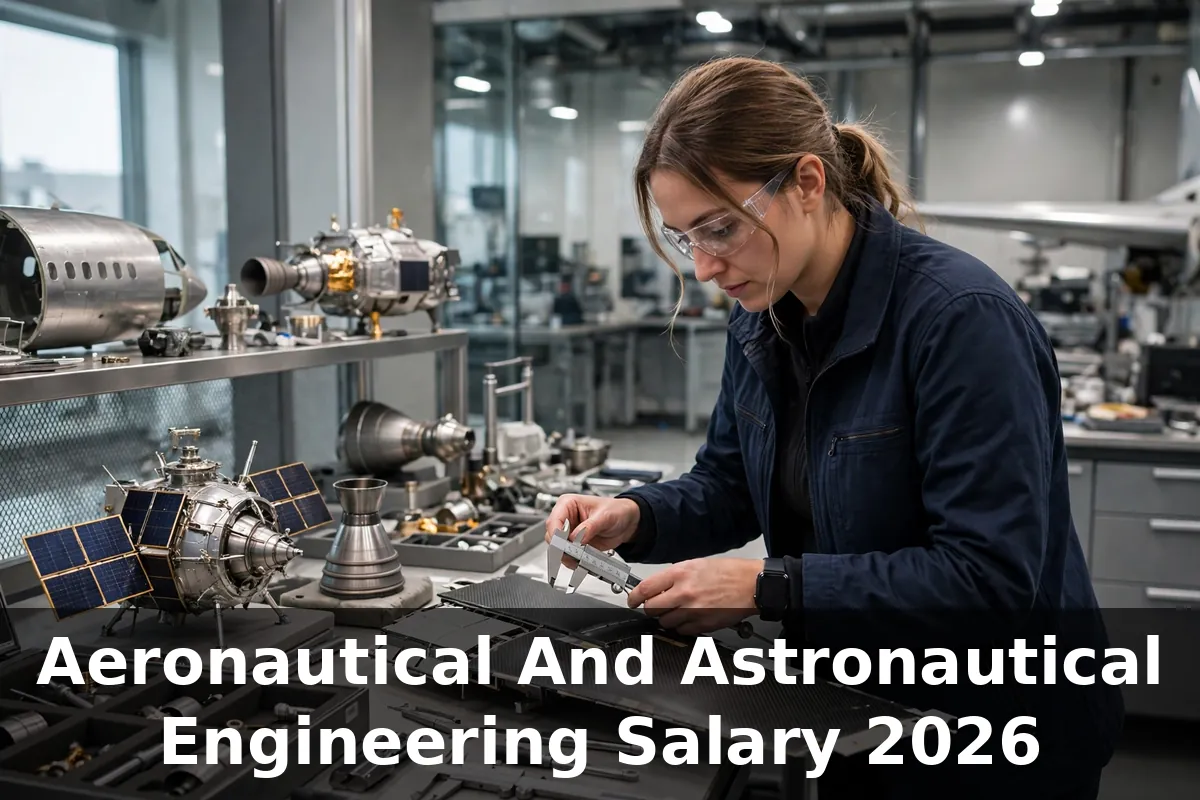
Aeronautical and Astronautical Engineering Salary 2026: Average Pay, Hourly Rates & Top-Paying States
If you are considering a career designing aircraft, spacecraft, or the systems that keep them flying, one question comes first: what does the aeronautical and astronautical engineering salary actually look like in 2026? The short answer is that it pays very well. The U.S. Bureau of Labor Statistics (BLS) puts the median annual wage for aerospace engineers at $134,830, and job boards such as ZipRecruiter report a similar average of about $130,258 a year. In other words, a typical engineer in this field earns more than two and a half times the median wage for all American workers.
There is one important naming point to clear up before the numbers. In government statistics, aeronautical engineers (who work on aircraft that fly within the atmosphere) and astronautical engineers (who work on spacecraft) are counted together under a single occupation: aerospace engineers. Employers use the same combined category in most job postings. So when you see a BLS figure for aerospace engineers, that figure is the best official measure of the aeronautical and astronautical engineering salary, and it covers both tracks.
Aeronautical and Astronautical Engineering Salary at a Glance
| Measure | Amount |
|---|---|
| BLS median annual wage | $134,830 |
| BLS median hourly wage | About $64.82 |
| ZipRecruiter average annual pay | $130,258 |
| ZipRecruiter average hourly pay | $62.62 |
| Bottom 10 percent (BLS) | $85,350 |
| Top 10 percent (BLS) | $205,850 |
| Typical entry level range | $74,000 to $102,000 |
| Job growth, 2024 to 2034 (BLS) | 6 percent |
These figures come from the most recent BLS Occupational Employment and Wage Statistics survey and from ZipRecruiter’s October 2026 job posting data. They describe base pay for full time work, and they do not include bonuses, overtime, stock awards, or the value of benefits, all of which can add a meaningful amount at larger employers.
Annual Salary vs Hourly Rate
Most aerospace engineers are salaried employees, so annual pay is the number that matters most. Still, hourly figures are useful when you compare a salaried offer with contract work. At the BLS median of $134,830, the hourly equivalent on a standard 2,080 hour work year is about $64.82. ZipRecruiter’s average of $130,258 works out to $62.62 an hour, or about $10,854 a month and $2,504 a week.
Hourly pay rises sharply with experience. Junior engineers often start near $36 to $49 an hour, while senior engineers and technical leads commonly clear $80 an hour in base pay alone. Contract and consulting roles can pay higher hourly rates, but they usually come without the paid leave, retirement contributions, and health coverage that salaried staff receive, so a straight hourly comparison can mislead.
Salary by Experience Level
Experience is the single biggest driver of pay in this field, ahead of even location. A new graduate hired by a defense prime typically starts between $74,000 and $102,000, with large contractors often opening near the top of that range for candidates with strong internship experience. After a few years, engineers who can own a subsystem, run tests, or lead small teams move into the $110,000 to $140,000 band.
| Experience level | Typical annual pay |
|---|---|
| Entry level (0 to 2 years) | $74,000 to $102,000 |
| Mid career (5 to 10 years) | $110,000 to $140,000 |
| Senior (10+ years) | $130,000 to $180,000+ |
| Principal, lead, or chief engineer | $180,000 to $205,850+ |
The aeronautical and astronautical engineering salary curve keeps climbing well past the ten year mark, because the field rewards deep specialization. Engineers who master propulsion, guidance and control, structural analysis, or systems integration become hard to replace, and employers pay accordingly. A master’s degree or doctorate can speed up that climb, especially for research heavy roles, though it is not required for most entry level jobs.
Salary by State and Location
Where you work matters a great deal, because aerospace jobs cluster around a handful of hubs. Washington state, home to Boeing and a growing commercial space presence, is frequently cited as a top paying state, with average pay running above the national level. California, Texas, Alabama, Colorado, and Florida also host large aerospace workforces, from NASA centers and military installations to private launch companies.
New York is another strong market: ZipRecruiter reports an average aeronautical engineer salary of about $142,507 there, roughly 9 percent above the national average. That said, high pay in coastal cities comes with high living costs, so the real value of an offer depends on rent, taxes, and commuting costs as much as on the headline number. Engineers in Huntsville, Alabama or Colorado Springs, Colorado sometimes keep more of their pay than peers earning more in Seattle or Los Angeles.
Salary by Industry and Employer Type
The type of employer shapes pay almost as much as experience. Major defense primes such as Lockheed Martin, Northrop Grumman, and RTX tend to offer solid base pay, structured raises, and strong benefits. Commercial space companies such as SpaceX are reported to pay higher on average, around $165,869 in some surveys, with top quartile pay near $216,000, but they are also known for demanding schedules.
Federal research labs and NASA centers offer stability, generous retirement benefits, and interesting work, though their base salaries can trail private industry at senior levels. Smaller suppliers and consulting firms vary widely: some pay a premium for niche skills, while others trade lower pay for broader experience. Security clearance is another quiet pay lever. Engineers who hold or can obtain a clearance qualify for defense roles that uncertified candidates cannot take, and that smaller talent pool often commands a premium.
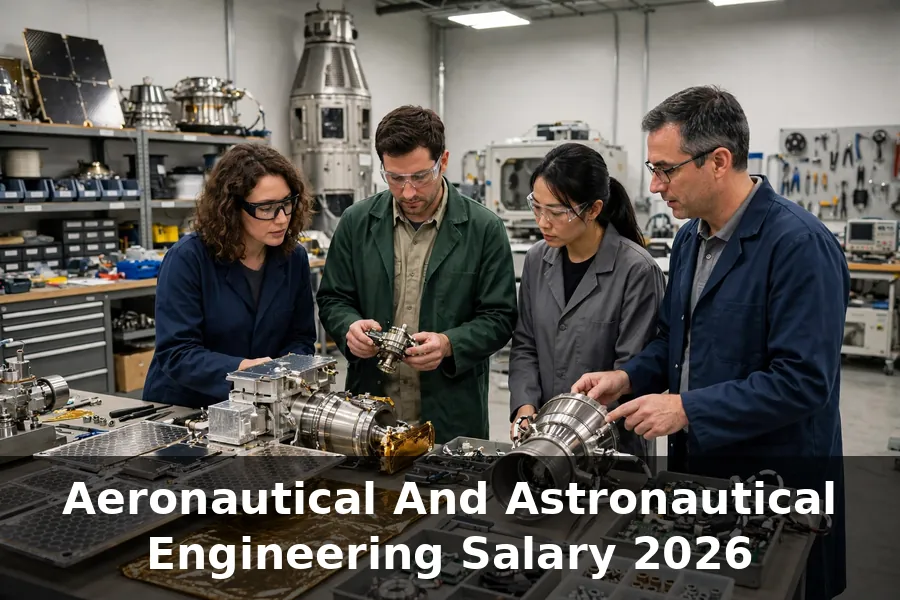
Aeronautical vs Astronautical: Does the Track Change Pay?
For most job seekers, the answer is no, not by much. Hiring managers generally treat the two tracks as one discipline, and BLS reports a single wage for both. If there is a tilt, it is modest: astronautical work leans slightly toward defense and commercial space, where average pay runs a little higher, while aeronautical work leans toward commercial aviation and defense aircraft, where pay is still strong but the range is somewhat wider. Your specialization within either track, for example propulsion or avionics, matters more than the label on your degree.
That is good news for students. Choosing between an aeronautical and an astronautical focus should come down to what excites you, not to a small pay gap that may disappear by the time you graduate. Both paths lead into the same well paid profession, and engineers commonly move between aircraft and spacecraft projects over a career.
Education and Skills Required
The standard entry point is a bachelor’s degree in aerospace engineering, or in mechanical engineering with aerospace coursework. Core subjects include aerodynamics, propulsion, structures, control systems, and orbital mechanics. Internships and cooperative education placements carry real weight with employers, because they prove you can apply classroom theory to real hardware and test data.
Skills that lift pay in 2026 include computational fluid dynamics, simulation and modeling, systems engineering, and familiarity with modern design and AI assisted analysis tools. Programming skills in Python or MATLAB, experience with CAD and finite element analysis, and a working knowledge of certification and safety standards all strengthen a resume. Professional Engineer (PE) licensure is less common in aerospace than in civil engineering, but it can help for roles involving public safety sign off.
Career Outlook for 2026 and Beyond
The BLS projects 6 percent employment growth for aerospace engineers from 2024 to 2034, about as fast as the average for all occupations. Demand is driven by commercial space travel, unmanned aerial systems, satellite constellations, and greener aviation technologies such as more efficient engines and sustainable fuels. Defense modernization programs add further demand, particularly for engineers with clearances.
Growth of 6 percent sounds modest, but it sits on top of a large, well paid workforce, and retirements among senior engineers open steady replacement demand. Candidates with hands on project experience, from university rocketry teams to industry internships, will have the strongest prospects. The field is competitive at the top employers, so a strong portfolio of projects matters as much as grades.
How to Increase Your Salary
If you are already in the field, a few moves reliably raise pay. First, specialize in a scarce skill such as guidance, navigation and control, or propulsion analysis. Second, consider a move to a higher paying hub or employer type, weighing living costs before you accept. Third, take on leadership: leading a subsystem team or owning a test campaign is the usual bridge from mid career pay to senior pay. Fourth, keep learning. Short courses in simulation tools, model based systems engineering, or program management can justify a raise or a better offer elsewhere.
Finally, negotiate with data. Knowing that the national median is $134,830 and that the top decile clears $205,850 gives you a credible range to anchor a conversation. Bring evidence of your own impact, such as test milestones met, weight saved, or schedules recovered, and employers will find it much harder to hold you to the bottom of a range.
Frequently Asked Questions
What is the average salary in this field in 2026?
The best official figure is the BLS median of $134,830 a year. Job board data is close: ZipRecruiter reports an average of about $130,258 a year. Most engineers fall between roughly $106,000 and $170,000, with the bottom 10 percent near $85,350 and the top 10 percent above $205,850.
How much do aerospace engineers make per hour?
At the BLS median, the hourly equivalent is about $64.82 on a standard full time schedule. ZipRecruiter’s average works out to $62.62 an hour. Entry level engineers typically earn $36 to $49 an hour, while senior engineers often exceed $80 an hour in base pay.
Which state pays aerospace engineers the most?
Washington is frequently ranked among the top paying states thanks to Boeing and commercial space employers, and New York averages about $142,507, above the national average. California, Texas, Alabama, and Colorado are also major hubs. Always compare pay against local living costs before judging an offer.
Do you need a master’s degree to earn a high salary?
No. A bachelor’s degree is enough for most entry level roles, and experience plus specialization drive the biggest raises. A master’s or doctorate helps for research intensive roles and can accelerate promotion, but many engineers reach senior pay bands on a bachelor’s degree plus strong project experience.
Is aerospace engineering a good career in 2026?
Yes, for people who enjoy hard technical problems. Pay is well above average, demand is steady with 6 percent projected growth, and the work spans aircraft, spacecraft, defense, and commercial space. The trade off is a demanding degree and competitive hiring at the best known employers.
Conclusion
The aeronautical and astronautical engineering salary in 2026 is among the strongest in all of engineering: a $134,830 median, a top decile above $205,850, and steady demand from aviation, defense, and commercial space. Your exact pay will depend on experience, specialization, clearance, employer type, and location, but the floor is high and the ceiling is higher still. If you love flight, whether inside the atmosphere or beyond it, this is a field where that passion pays.