
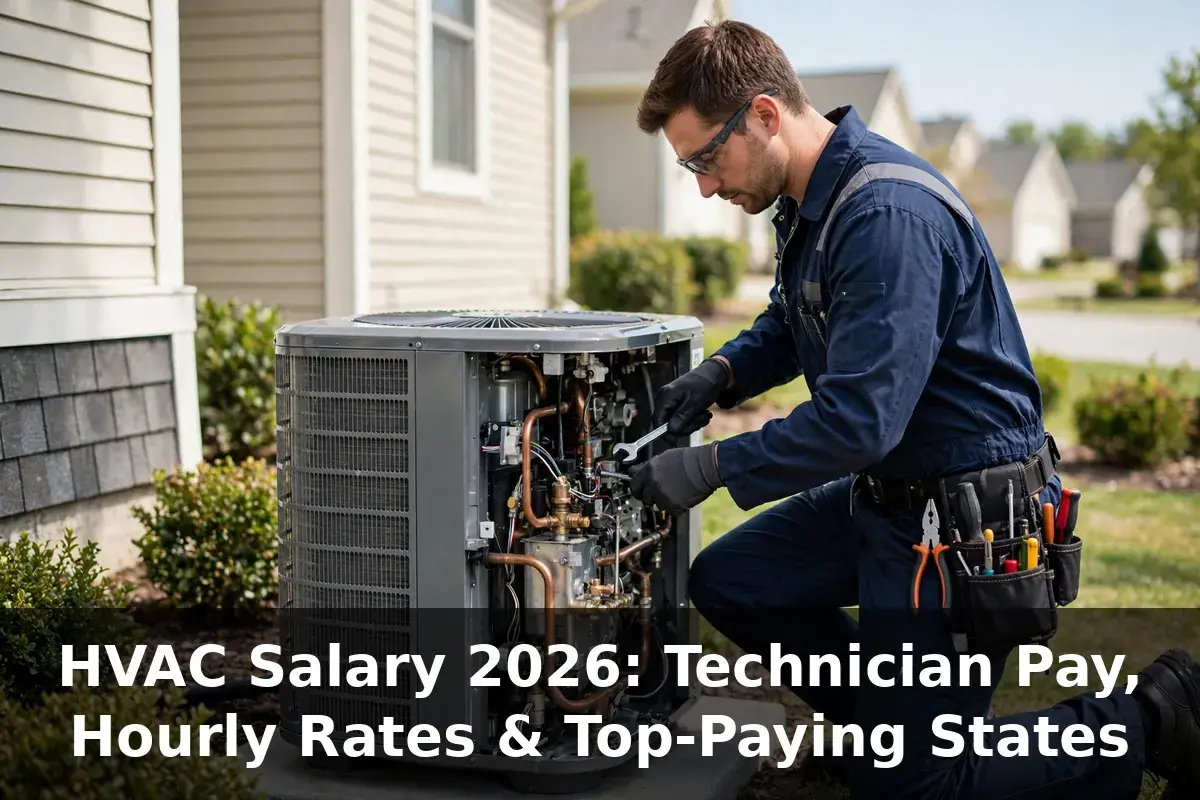
HVAC Salary 2026: Technician Pay, Hourly Rates & Top-Paying States
If you’re thinking about getting into the trades, few questions matter more than the honest one: how much do HVAC technicians actually make? The short version is that it’s solid money for work that doesn’t require a college degree — and the ceiling climbs fast once you know what you’re doing. Let’s break down the real 2026 numbers.
Quick Answer: What Is the Average HVAC Salary in 2026?
The median HVAC technician salary in the United States is $61,010 per year ($29.33 per hour), according to the latest Bureau of Labor Statistics data (May 2025). That means half of all techs earn more, half earn less. The spread is wide: the bottom 10% bring home around $40,050 a year, while the top 10% clear $95,210 — and job-advertisement data shows the highest earners pushing well past $100,000.
Here’s the catch most salary roundups bury in the footnotes: where you work and what kind of HVAC work you do moves that median more than almost anything else. A commercial service tech in Washington, D.C. and a residential installer in rural Mississippi are technically in the same occupation — but their paychecks barely resemble each other. This guide covers the whole picture so you know where you’d land.
HVAC Technician Salary Breakdown: Annual, Monthly, Weekly & Hourly
Below is the national pay picture from the BLS (May 2025 Occupational Employment data), laid out by pay period so you can see exactly what the median looks like in practical terms.
| Pay Period | Median Pay |
|---|---|
| Hourly | $29.33 |
| Weekly (40 hrs) | $1,173 |
| Monthly | $5,084 |
| Annual | $61,010 |
And here’s how the full range shakes out — bottom 10%, median, and top 10%:
| Percentile | Hourly | Annual |
|---|---|---|
| Bottom 10% | $19.25 | $40,050 |
| 25th percentile | ~$23.12 | ~$48,080 |
| Median (50th) | $29.33 | $61,010 |
| 75th percentile | ~$35.97 | ~$74,820 |
| Top 10% | $45.77 | $95,210 |
Source: BLS OEWS, May 2025 (latest published). ZipRecruiter’s February 2026 market data — based on live job postings — puts the average at $65,635/year ($31.56/hr), a little above the BLS median, which makes sense: postings skew toward employers actively hunting talent.
One thing worth noting before we go further: BLS data covers base wages only. It doesn’t count overtime, on-call bonuses, or commissions — and in HVAC, those aren’t footnotes. They’re a real chunk of what many techs take home.
HVAC Salary Per Month: What Lands in Your Bank Account
Most job ads quote annual figures, but what you actually feel is the monthly deposit. At the national median of $61,010, that’s roughly $5,084 per month before taxes. In practice, a mid-career tech with a bit of overtime typically sees somewhere between $4,200 and $5,500 monthly take-home, depending on state taxes and deductions.
Why bring this up? Because HVAC is one of those trades where the base number understates reality. Peak season — a brutal July in Texas or a January cold snap in Minnesota — brings overtime and emergency callouts that can add $8,000–$20,000 a year on top of base pay. If you’re comparing offers, always ask about on-call pay and overtime policies, not just the hourly rate.
HVAC Technician Hourly Rates (The Number Everyone Asks About)
Hourly intent is huge for this keyword, so let’s not dance around it. In 2026:
- Entry-level / apprentice: $18–$24/hr
- Junior tech (2–4 years): $25–$32/hr
- Senior tech (4–8 years): $32–$41/hr
- Lead / master tech (8+ years): $41–$53+/hr
Non-union shops generally hire in the $18–$30/hr band for standard roles, while union positions typically land in the $25–$45/hr range, with the total package (benefits, pension contributions) widening the gap further. Commercial and industrial specialists routinely sit $5–$10 above the residential average — which is why you’ll see so many experienced techs migrate toward commercial work once they have the chops.
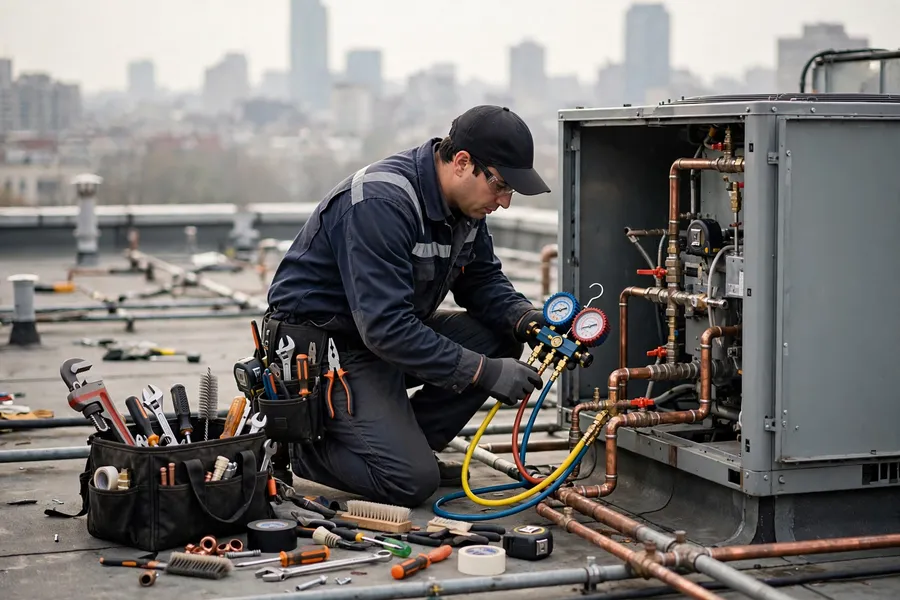
Apprentice HVAC Salary: Getting Paid While You Learn
The apprenticeship path is arguably the single best financial deal in this trade. You’re earning from week one — no tuition debt, no four years of waiting. Apprentices typically earn 40–50% of a journeyman’s wage, working out to roughly $39,000–$50,000 a year ($18–$24/hr).
Union apprenticeships through UA (United Association) or SMART locals tend to pay best, often starting apprentices at 50–65% of the journeyman rate from day one. Non-union shops vary more — but in today’s tight labor market, many match union pay by year three or four just to keep people. Compare that to a four-year degree, which can cost $80,000–$200,000 before you earn a dime, and the math starts looking very friendly.
HVAC Salary by Experience Level
Experience is the biggest single lever on your paycheck in this field. The climb from apprentice to master tech can more than double your income.
| Experience Tier | Years | Annual Salary | Hourly Rate |
|---|---|---|---|
| Apprentice | 0–2 | $39,000–$50,000 | $18–$24 |
| Junior technician | 2–4 | $52,000–$66,000 | $25–$32 |
| Senior technician | 4–8 | $67,000–$85,000 | $32–$41 |
| Lead / master technician | 8+ | $85,000–$110,000+ | $41–$53+ |
Ranges compiled from 2025–2026 job-posting market data; BLS percentiles above are the official baseline.
Why such a steep curve? Because the value of a tech isn’t measured in hours — it’s measured in how fast they diagnose the problem. An owner pays a senior tech more because a 20-minute diagnosis beats a two-hour one, and because experienced techs close bigger tickets and handle installs solo. Every skill milestone you hit — EPA certification, NATE, commercial work — moves you up this table.
Sector Breakdown: Residential vs. Commercial vs. Union vs. Non-Union
This is where HVAC pay stories diverge. Two techs with identical years in the trade can be $20,000 apart based purely on sector.
Residential vs. commercial HVAC pay
Commercial work pays roughly 15–30% more than residential. Employee-reported data puts residential technicians around $23.65/hr versus $28.56/hr for commercial techs. The logic is simple: a dead rooftop unit at a hospital or a data center costs the client serious money, and that pressure flows straight into wages. Controls technicians, refrigeration specialists, and building-automation techs sit at the top of this ladder.
Residential has its own upside, though. Smaller shops often hand out commissions and “spiffs” for selling maintenance agreements or upselling replacements — and if you’re personable, those add up. You’ll also hit lead roles sooner in a small company than at a large commercial contractor.
Who you work for matters too
BLS breaks the trade into employer classes, and the gap is eye-opening:
| Employer Type | Median Annual Pay (BLS, May 2025) |
|---|---|
| Wholesale trade (distributors, manufacturers) | $71,190 |
| Retail trade | $62,830 |
| Educational services (schools, universities) | $62,520 |
| Plumbing, heating & AC contractors | $60,030 |
Here’s the kicker: 68% of the occupation works for contractors — the lowest-paying class in the table. Keep that in mind when evaluating offers. Government and institutional employers (counties, school districts, universities) also offer excellent union-backed packages with pensions, though those jobs are competitive.
Union vs. non-union
Unionized HVAC technicians earn an estimated 20–30% more in base pay than non-union counterparts, with typical ranges around $25–$45/hr versus $18–$30/hr. Just as important, union contracts usually include structured raises, full health coverage, and pension plans — benefits non-union shops provide inconsistently, if at all. The trade-off: dues, union rules, and sometimes less scheduling flexibility. For a long-term career, most techs find the math favors the union side.
Curious how union trades stack up across the board? Our breakdown of union ironworker salaries in the US covers another heavy-hitter trade where the union premium shapes the whole pay picture.
HVAC Salary by State: Where Techs Earn the Most in 2026
Location is the other half of the paycheck equation. Climate, local economy, union density, and cost of living create dramatically different salary environments. According to BLS state-level data, the District of Columbia leads at roughly $84,390 median, followed by Alaska, Illinois, Massachusetts, and Connecticut.
| State | Median Annual Pay | vs. National Median |
|---|---|---|
| District of Columbia | ~$84,390 | +38% |
| Alaska | ~$75,000+ (est.) | +23% |
| Illinois | ~$73,000+ (est.) | +20% |
| Massachusetts | ~$72,000+ (est.) | +18% |
| Connecticut | ~$71,000+ (est.) | +16% |
| New York | ~$70,000+ (est.) | +15% |
| California | ~$69,000+ (est.) | +13% |
| Washington | ~$68,000+ (est.) | +11% |
| Hawaii | ~$67,000+ (est.) | +10% |
| New Jersey | ~$66,000+ (est.) | +8% |
Top-state figures combine BLS medians and current market estimates; check local postings for precision.
On the flip side, states like Mississippi, West Virginia, Arkansas, and Georgia sit at the bottom — Georgia around $49,635 and West Virginia near $45,507 annually. But here’s the part people forget: a $60,000 salary in Wichita, Kansas buys more life than $75,000 in San Francisco. Run every comparison through a cost-of-living calculator before you let a headline number make the decision for you.
High-employment states tell a different story worth hearing: Florida, California, and Texas employ the most techs by far. Median wages there sit near the national average — but the sheer volume of openings, plus states like Texas and Florida having no state income tax, makes the take-home math competitive. For a similar trade comparison, see our electrician salary guide — another hands-on field where state choice swings pay dramatically.
Factors Affecting HVAC Technician Salary
Several variables stack together to determine where you land on the pay scale:
- Experience level — the steepest curve in the skilled trades; see the table above.
- Certifications — EPA 608 is mandatory; NATE certification is estimated to add around $15,000/year versus uncertified peers.
- Specialization — refrigeration, geothermal, building automation, and commercial controls command the highest premiums.
- Sector — commercial/industrial outpays residential by 15–30%; union outpays non-union by 20–30%.
- Location — top states pay 30–40% above the median; bottom states run 20–25% below it.
- Employer type — distributor and manufacturer-side roles top out higher than contractor-side work.
- Overtime and on-call — peak-season overtime can add $8,000–$20,000 annually.
- Business ownership — owner-operators can clear $100,000–$300,000+, with all the risk and overhead that implies.
What Does an HVAC Technician Do?
HVAC stands for heating, ventilation, and air conditioning — and techs are the people who keep all three running. On a typical day, a technician might diagnose a dead compressor at a home, install a new furnace in a new-build, troubleshoot a commercial rooftop unit, recharge refrigerant lines, wire thermostats and control systems, and run preventive maintenance to catch failures before summer hits.
The work is hands-on and physical: attics, crawl spaces, rooftops, ladders, and carrying heavy equipment are daily realities. It’s also increasingly technical — modern systems involve digital controls, variable-speed drives, and refrigerants with strict environmental regulations. The tech who understands both the wrench and the software is the one who commands the top rates.
HVAC Qualification & Certification Requirements
The barrier to entry is low; the barrier to good pay is credentials. Here’s the standard stack:
- High school diploma or GED — the baseline most employers require.
- EPA Section 608 certification — federally required to handle refrigerants. It’s the cheapest federal license in the American economy: the exam typically costs $20–$60 and can be taken as an online proctored exam. If you do nothing else, do this.
- Trade school or apprenticeship — trade school runs $3,000–$15,000; apprenticeships pay you from day one and are often the better deal.
- NATE certification — North American Technician Excellence; the industry’s gold-standard credential, with an estimated $15,000/year pay premium.
- State and local licenses — requirements vary wildly by state; some require journeyman or master licenses for independent work.
- Manufacturer certifications — Carrier, Trane, Daikin and others certify techs on their equipment; these open doors at distributors and large commercial firms.
How to Become an HVAC Technician
The path is refreshingly straightforward — no four-year degree, no six-figure debt:
- Finish high school or get your GED. Math and basic physics comfort helps, but nothing exotic is needed.
- Pick your training route. Either enroll in a trade school program (6 months–2 years, $3k–$15k) or — better — land a paid apprenticeship through a local contractor or a UA/SMART union local. Union apprenticeships are competitive and sometimes interview only once a year, so apply early and to several programs at once.
- Get your EPA 608. This is non-negotiable — you can’t legally touch refrigerant without it. The exam is affordable and quick.
- Complete your apprenticeship or program. Expect 3–5 years of combined classroom and on-the-job training to reach journeyman level.
- Stack certifications. NATE, manufacturer certs, and state licenses each unlock higher-paying work.
- Specialize. Once you’re solid, move toward commercial, refrigeration, or building automation — that’s where the $90k+ territory lives.
HVAC Career Growth & Job Outlook
This is the part that should genuinely excite you. The BLS projects 11% employment growth from 2025 to 2035 for HVAC mechanics and installers — much faster than the average occupation — with roughly 40,600 openings per year driven by retirements, new construction, and the ongoing replacement of aging systems.
Several tailwinds are strengthening demand further: the push for energy-efficient systems, new low-GWP refrigerants (like R-454B and R-32) that require retrained techs, data-center buildouts needing serious cooling, and indoor-air-quality upgrades across commercial buildings. The typical career arc runs apprentice → junior tech → senior tech → lead/master → supervisor or service manager ($110,000–$150,000+) → business owner. Each rung is real, and each one pays.
Benefits HVAC Technicians Typically Receive
Base pay tells half the story. Typical benefits packages in the trade include:
- Health insurance — most established shops offer it; coverage typically kicks in within 90 days.
- Retirement plans — 401(k) with employer match is common; union shops add pensions.
- Paid time off — vacation, sick leave, and paid holidays scale with tenure.
- Company vehicle and tools — many employers provide the van, fuel card, and major tools.
- Ongoing training — manufacturer training and certification courses, often employer-paid.
- Overtime and on-call pay — time-and-a-half and emergency callout bonuses during peak seasons.
FAQs About HVAC Technician Salary
How much does an HVAC technician make per hour in 2026?
The national median is $29.33/hour (BLS, May 2025). Most techs fall between $19 and $46 an hour, with entry-level around $18–$24/hr and master techs at $41–$53+/hr. ZipRecruiter’s job-posting data puts the average a bit higher at $31.56/hr.
Is HVAC a good career choice in 2026?
Yes — for the right person. It offers above-median pay without college debt, 11% projected job growth, and a clear path from apprentice ($40k) to six figures. The trade-offs are physical labor, hot attics, on-call rotations, and seasonal intensity.
How much do apprentice HVAC techs make?
Apprentices earn roughly $39,000–$50,000 per year ($18–$24/hr) — typically 40–50% of a journeyman’s wage, or 50–65% in union programs. You’re paid from day one, which makes it one of the best earn-while-you-learn setups in any trade.
Do HVAC techs make more than electricians?
They’re close cousins. Electricians run slightly ahead nationally, but at the senior and specialist levels the two trades converge — and commercial HVAC specialists can out-earn residential electricians. Both beat the national median for all occupations comfortably.
How much do union HVAC technicians make?
Union techs typically earn $25–$45/hr, about 20–30% more than non-union techs in comparable roles. The gap widens when you count the full package: pensions, premium health coverage, and structured raises.
What is the highest-paying HVAC specialty?
Building automation/controls technicians, commercial refrigeration specialists, and industrial HVAC techs sit at the top — routinely in the $76,000–$110,000+ range. HVAC service managers and estimators can clear $110,000–$150,000.
How long does it take to become a well-paid HVAC technician?
Most techs reach comfortable senior-level pay ($67k–$85k) within 4–8 years. The master/lead tier ($85k+) generally takes 8+ years, though certifications and commercial specialization can compress that timeline.
Is NATE certification worth it?
Industry data suggests NATE-certified techs earn an estimated $15,000 more per year than uncertified peers. Given the modest exam cost, it’s one of the highest-ROI moves a tech can make.
Can HVAC technicians make six figures?
Yes. The BLS top 10% exceeds $95,000, and job-market data shows senior commercial techs, specialists, and union lead techs clearing $100,000 — particularly with overtime. Business owners can go well beyond that.
Do HVAC technicians get overtime?
Almost universally. Peak seasons (summer heat waves, winter cold snaps) bring heavy overtime at time-and-a-half, plus on-call and emergency premiums. Many techs add $8,000–$20,000 to their base pay this way.
Conclusion: Is the HVAC Salary Worth It?
The numbers tell a straightforward story: a median of $61,010, a realistic path to $85,000–$110,000+ for experienced techs, 11% job growth, and entry that costs you little more than a willingness to work hard and learn. There are very few careers left that offer this combination — no college debt, paid training from day one, and a genuine six-figure ceiling for specialists and owners.
The highest earners in this trade share a pattern: they got certified early, moved into commercial or specialized work, and either joined a strong union local or built their own shop. If you follow that playbook, the HVAC salary in 2026 isn’t just a decent living — it’s a foundation. Not sure how hourly wages convert to yearly take-home? Our guide on what $25 an hour really pays walks through the exact math.






One Comment