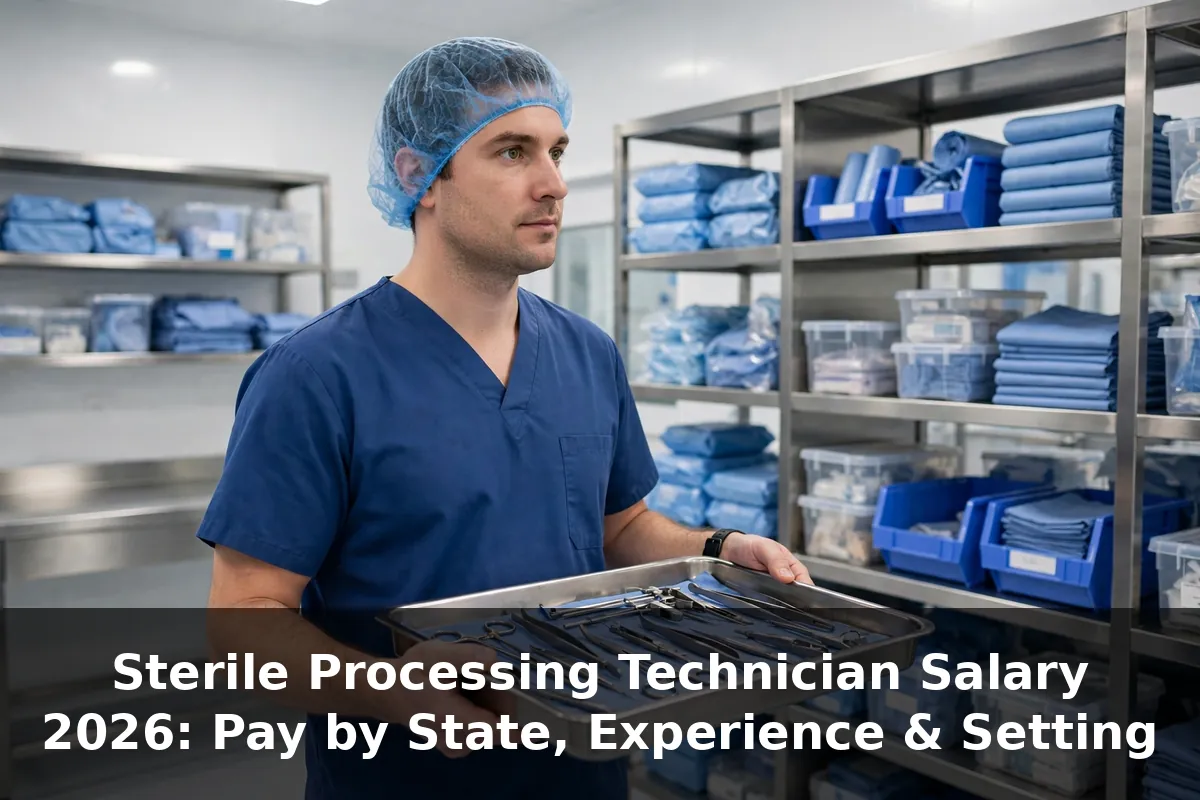
Sterile Processing Technician Salary 2026: Pay by State, Experience & Setting
Behind every successful surgery is a team you never see. While surgeons and nurses get the spotlight, sterile processing technicians — the specialists who decontaminate, assemble, and sterilize surgical instruments — keep the entire operating room running. The good news? It’s one of the few healthcare careers you can enter with less than a year of training and still land a solid middle-class paycheck.
So what does a sterile processing technician actually earn in 2026? Here’s the honest breakdown.
Quick Answer: How Much Do Sterile Processing Technicians Make?
- National median (BLS, employer-reported, 2025 data): $47,700/year — about $22.93/hour
- Job-advertisement average (ZipRecruiter, Sept 2026): $57,186/year — about $27.49/hour
- Typical staff range: $35,000–$65,000/year ($17–$30/hour)
- Entry-level: around $35,000–$45,000/year
- Experienced / certified techs: $55,000–$70,000/year
- Travel sterile processing techs: $60,000–$80,000+ total compensation
- Supervisors and managers: $70,000–$90,000+/year
The BLS figure is the most reliable benchmark — it comes from a massive survey of employers — while job-board averages like ZipRecruiter’s tend to run higher because they scan advertised wages, which skew toward openings employers are actively competing to fill.
National Sterile Processing Technician Salary: The Full Picture
The Bureau of Labor Statistics tracks this job under the occupation “medical equipment preparers,” which explicitly includes sterile processing technicians, central service technicians, and CRCST holders. Here is what the latest verified data shows:
| Source | Year | Median Annual | Median Hourly | Data Type |
|---|---|---|---|---|
| BLS OEWS | 2025 | $47,700 | $22.93 | Employer-reported survey |
| ZipRecruiter | Sept 2026 | $57,186 (avg) | $27.49 (avg) | Job advertisement scan |
| 2026 industry estimate | 2026 | ~$49,700 | ~$23.90 | Projected median |
The median means half of all techs earn more and half earn less — it’s a better measure than an average, which a handful of very high salaries can pull upward.
Sterile Processing Technician Salary Per Hour, Week, Month, and Year
Hourly pay is the number that matters most day to day, and it’s what most job postings actually list. Based on the BLS median of $22.93/hour (40 hours/week):
| Pay Period | Amount |
|---|---|
| Per hour | $22.93 |
| Per week | $917 |
| Per month | $3,975 |
| Per year | $47,700 |
Keep in mind these are base figures. Night and weekend shift differentials commonly add 10–15% on top of base pay, and overtime is frequent in busy hospital departments — which is why many techs’ take-home pay lands noticeably above the median.
Entry-Level Sterile Processing Technician Salary
Starting out, expect a modest but livable wage. New technicians — fresh out of a training program, usually uncertified at first — typically start between $35,000 and $45,000 per year ($16.80–$21.65/hour, industry estimates for 2026).
Your starting offer depends heavily on three things: where the hospital is, whether the facility is short-staffed (many are), and whether you’ve already passed the CRCST exam. Walk in certified and you can often negotiate toward the top of the entry range — or skip the bottom of it entirely.
Sterile Processing Technician Salary by Experience Level
Pay climbs steadily with experience, but the biggest single jump comes from certification rather than years alone. Here’s the typical progression:
| Experience Level | Annual Range | What’s Typical |
|---|---|---|
| Entry-level (0–1 years) | $35,000–$45,000 | Training program graduate, possibly uncertified |
| Mid-level (2–5 years) | $45,000–$55,000 | CRCST certified, works independently |
| Experienced (5+ years) | $55,000–$70,000 | Multiple certifications, lead tech duties |
| Supervisor / Manager | $70,000–$90,000+ | Oversees department, on-call responsibility |
Ranges are aggregated industry estimates for 2026; individual offers vary by market.
Many techs find the sweet spot around years 3–5: by then you’re certified, fast, and trusted with complex instrument sets — and hospitals pay for that reliability.
Take-Home Pay: What Technicians Actually Keep
The published salary figures are gross pay, before taxes and deductions. What lands in your bank account depends on your state (income tax or none — Texas and Florida techs keep more of the same gross), shift differentials, overtime, and benefits like health insurance premiums.
A few honest take-home notes:
- Shift differentials are real money. Evening and night shifts commonly pay 10–15% extra per hour. A tech earning a $22/hour base can effectively make $25+/hour on nights.
- Overtime adds up fast. Sterile processing departments rarely close. On-call weekends and holiday coverage, often paid at time-and-a-half, can add several thousand dollars a year.
- Certification raises stick. The widely cited industry figure is that CRCST-certified techs earn roughly $2–$4 more per hour than uncertified peers — that’s $4,000–$8,000 a year for passing one exam.
Sterile Processing Technician Salary by Work Setting
Where you work matters almost as much as how long you’ve worked. Here’s how the main settings compare:
| Setting | Typical Annual Range | Notes |
|---|---|---|
| Hospital (staff) | $40,000–$65,000 | Largest employer; differentials and OT common |
| Outpatient surgery center | $38,000–$55,000 | Regular daytime hours, less OT |
| Travel / contract tech | $60,000–$80,000+ | Highest pay, but includes housing/meals stipends |
| Dental / clinic settings | $32,000–$45,000 | Lower pay, smaller scope |
| Government / VA hospitals | $42,000–$62,000 | Structured pay scales, strong benefits |
Travel roles deserve a closer look. Travel sterile processing technicians earn $40–$50 per hour in many markets — but that number is inflated by tax-free housing and meal stipends bundled into the package, not pure wages. Even so, total compensation of $70,000–$80,000+ for 13-week contracts is realistic for certified travelers, which is why experienced techs often do a year or two of travel early in their careers.
Sterile Processing Technician Salary by State
Geography is the single biggest pay driver. The BLS employer survey (May 2025) puts California at the top with a median of $62,710, while lower-cost states sit in the low-to-mid $40,000s. Here are the published state medians:
| State | Median Annual | Median Hourly |
|---|---|---|
| California | $62,710 | $30.15 |
| Massachusetts | $51,610 | $24.81 |
| Washington | $51,190 | $24.61 |
| New York | $51,880 | $24.94 |
| New Jersey | $49,090 | $23.60 |
| Oregon | $49,050 | $23.58 |
| Minnesota | $48,580 | $23.36 |
| Maryland | $47,630 | $22.90 |
| Illinois | $47,100 | $22.64 |
| Colorado | $46,870 | $22.53 |
| Georgia | $46,700 | $22.45 |
| Texas | $46,010 | $22.12 |
| Arizona | $46,060 | $22.14 |
| Michigan | $45,230 | $21.75 |
| Wisconsin | $46,170 | $22.20 |
Source: BLS Occupational Employment & Wage Statistics, May 2025 (medical equipment preparers). Within states, metro areas pay more — San Francisco-area medians run above $80,000, while smaller markets track the state average.
Bottom line: the coastal and high-cost states pay 30–40% more than the national median, but the cost of living eats much of that difference. A $52,000 salary in Minnesota can go further than $60,000 in California.
Factors That Affect Sterile Processing Technician Pay
Beyond state lines, these are the levers that move your paycheck:
- Certification. CRCST is the big one. It signals competence to employers and is the fastest way to a raise — often $2–$4/hour more.
- Specialty certifications. CIS (instrument specialist) and CER (endoscope reprocessing) open doors to higher-paying niches like endoscopy suites.
- Shift. Nights, evenings, and weekends carry differentials of 10–15%.
- Facility type and size. Large trauma centers and academic hospitals pay more than small community hospitals — the instrument volume and complexity are on another level.
- Union status. Unionized hospital departments frequently negotiate higher base rates and guaranteed differentials.
- Experience with complex sets. Orthopedic, cardiac, and robotic instrument sets take longer to master and command premium pay in large OR programs.
- Travel willingness. Contract work pays the most per hour, with the trade-off of relocating every few months.
What Does a Sterile Processing Technician Actually Do?
The job title undersells the responsibility. A sterile processing technician is the last line of defense between a patient and a surgical site infection. A typical shift includes:
- Decontamination — receiving used instruments and cleaning them in washers and ultrasonic cleaners
- Inspection and assembly — examining every instrument under magnification, testing function, and assembling complete surgical trays
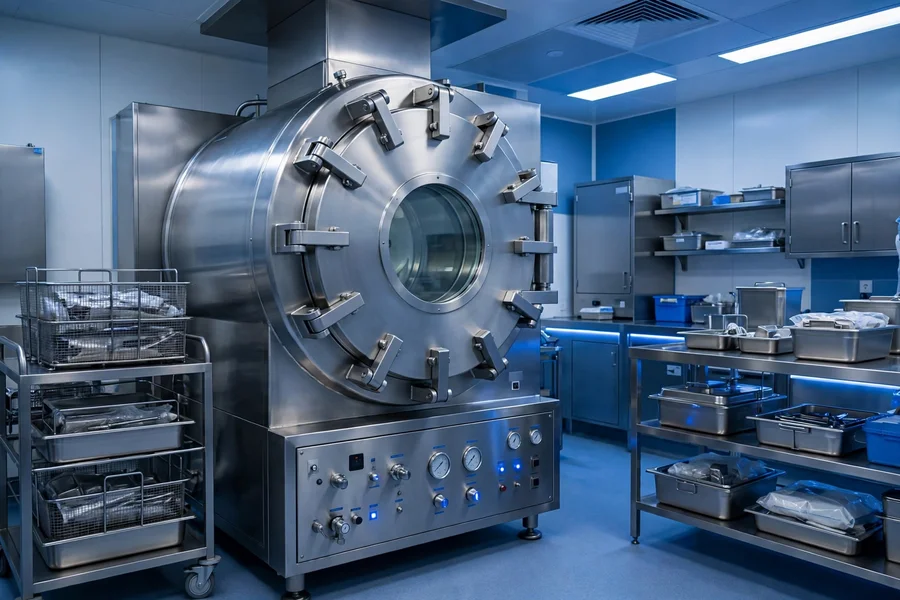
- Sterilization — running steam autoclaves, low-temperature sterilizers, and biological indicators
- Storage and distribution — maintaining sterile inventory and delivering case carts to operating rooms on schedule
- Documentation — tracking every tray through every cycle for regulatory compliance
It’s detail-heavy, physical work (you’re on your feet, lifting trays), and largely behind the scenes. Many techs love it precisely because there’s no bedside patient care — just you, the instruments, and the quiet satisfaction of getting every tray exactly right.
Qualification and Certification
The barrier to entry is refreshingly low: most employers require a high school diploma or GED plus completion of a sterile processing training program. Programs typically run 6–8 months (some accelerated options finish in about 16 weeks) and include classroom work plus a hands-on clinical externship — usually around 400 hours in a real hospital department.
The credentials that matter, all administered by the Healthcare Sterile Processing Association (HSPA, formerly IAHCSMM) or the Certification Board for Sterile Processing and Distribution (CBSPD):
- CRCST — Certified Registered Central Service Technician. The core credential; HSPA counted over 54,000 current holders at the end of 2025.
- CIS — Certified Instrument Specialist. For techs who want deep expertise in surgical instrumentation.
- CER — Certified Endoscope Reprocessor. Specialized for flexible endoscope reprocessing — a growing, well-paid niche.
- CHL — Certified Healthcare Leader. For those moving into supervision and management.
A handful of states — including New Jersey and Pennsylvania — legally require technicians to earn certification within a set period after being hired. Even where it’s not law, most hospitals strongly prefer or require it, and it pays for itself within months.
How to Become a Sterile Processing Technician
- Earn a high school diploma or GED.
- Complete a sterile processing training program (6–8 months, including a clinical externship).
- Pass the CRCST exam — many programs build exam prep into the curriculum.
- Apply to hospitals and surgery centers — highlight your externship hours; they count as experience.
- Add specialty certifications (CIS, CER) after a year or two to unlock higher-paying roles.
- Consider travel contracts or leadership tracks once you’re experienced and certified.
Total time from starting a program to your first paycheck: often under a year. Training costs are modest compared to most healthcare careers, and many techs recoup them within their first few months of work.
Career Growth and Advancement
Sterile processing isn’t a dead end — it’s a launchpad. Common paths:
- Lead technician / educator — train new hires, own the complex trays
- Supervisor or department manager — $70,000–$90,000+, with the CHL credential helping
- Travel technician — top hourly pay with stipends
- Sales or clinical specialist for instrument and sterilizer manufacturers
- Adjacent clinical roles — many techs go on to become surgical technologists, a natural step up that works in the operating room itself
Compared with other short-training healthcare roles, sterile processing holds its own: it sits above phlebotomist pay and medical assistant salary levels nationally, while requiring similar training time.
Benefits Beyond the Paycheck
Hospital employment usually comes with a benefits package that meaningfully boosts total compensation:
- Health, dental, and vision insurance
- Retirement plans (403(b) or 401(k), often with employer match)
- Paid time off and paid holidays
- Tuition reimbursement for further certifications
- Shift and weekend differentials
- Job security — with an 11% projected growth rate, this is one of healthcare’s steadier bets
Job Outlook: Is Demand Growing?
Yes — strongly. The BLS projects employment for medical equipment preparers to grow 11% from 2025 to 2035, much faster than the average for all occupations, rising from about 79,900 to 88,600 jobs. An aging population means more surgeries, more surgeries mean more instruments, and every one of them has to pass through a sterile processing department. Infection-control standards keep tightening too, which only raises the bar — and the value — of trained, certified techs.
FAQs About Sterile Processing Technician Salary
How much do sterile processing technicians make per hour?
The BLS median is $22.93/hour (2025 employer data). Job postings tracked by ZipRecruiter average $27.49/hour. Most staff techs earn between $17 and $30 an hour depending on state, certification, and shift.
What is the highest-paying state for sterile processing technicians?
California leads with a BLS median of $62,710/year, followed by Massachusetts, Washington, and New York in the low $50,000s. Major metros like San Francisco push past $80,000.
Do sterile processing technicians make good money for the training required?
Yes — it’s one of the better returns in allied health. Six to eight months of training can lead to a $47,700 median salary with a clear path to $60,000–$70,000 as a certified, experienced tech.
Do you need certification to work as a sterile processing technician?
Not everywhere by law, but effectively yes. Most hospitals require or strongly prefer the CRCST credential, a few states mandate it within a set time after hire, and certified techs earn roughly $2–$4/hour more.
How long does it take to become a sterile processing technician?
Most training programs run 6–8 months including a clinical externship; accelerated programs can finish in about 16 weeks. You can be working within a year of starting.
How much do travel sterile processing technicians make?
Travel techs commonly earn $40–$50/hour in total package value, translating to $60,000–$80,000+ per year — but part of that is tax-free housing and meal stipends, not straight wages.
What’s the difference between CRCST, CIS, and CER?
CRCST is the foundational certification for central sterile work. CIS specializes in surgical instrumentation expertise, and CER covers flexible endoscope reprocessing. Many experienced techs hold two or more.
Can you move up from sterile processing technician?
Absolutely. Lead tech, supervisor, and department manager roles pay $70,000–$90,000+. Others move into travel work, vendor sales, or adjacent clinical careers like surgical technology or radiology technology.
Is sterile processing a stressful job?
It can be fast-paced — the OR can’t start without your trays — and it’s physically demanding. But there’s no direct patient care, the work is structured and procedural, and many techs find the routine genuinely satisfying.
Do sterile processing technicians work nights and weekends?
Often, yes. Hospitals run around the clock, and off-shift work comes with 10–15% pay differentials, which is part of why actual earnings frequently beat the published medians.
Conclusion
A sterile processing technician salary in 2026 lands at a $47,700 national median — solid middle-class pay for under a year of training, with real upside for certified techs in high-demand states and travel roles. Certification is the single best investment you can make in this career: one exam, a few dollars more per hour, and a noticeably wider set of job options.
If you want steady healthcare work without years of school or direct patient care, few careers offer a better trade. Check openings in your state, get the CRCST on your resume, and let the night-shift differential do the rest.