
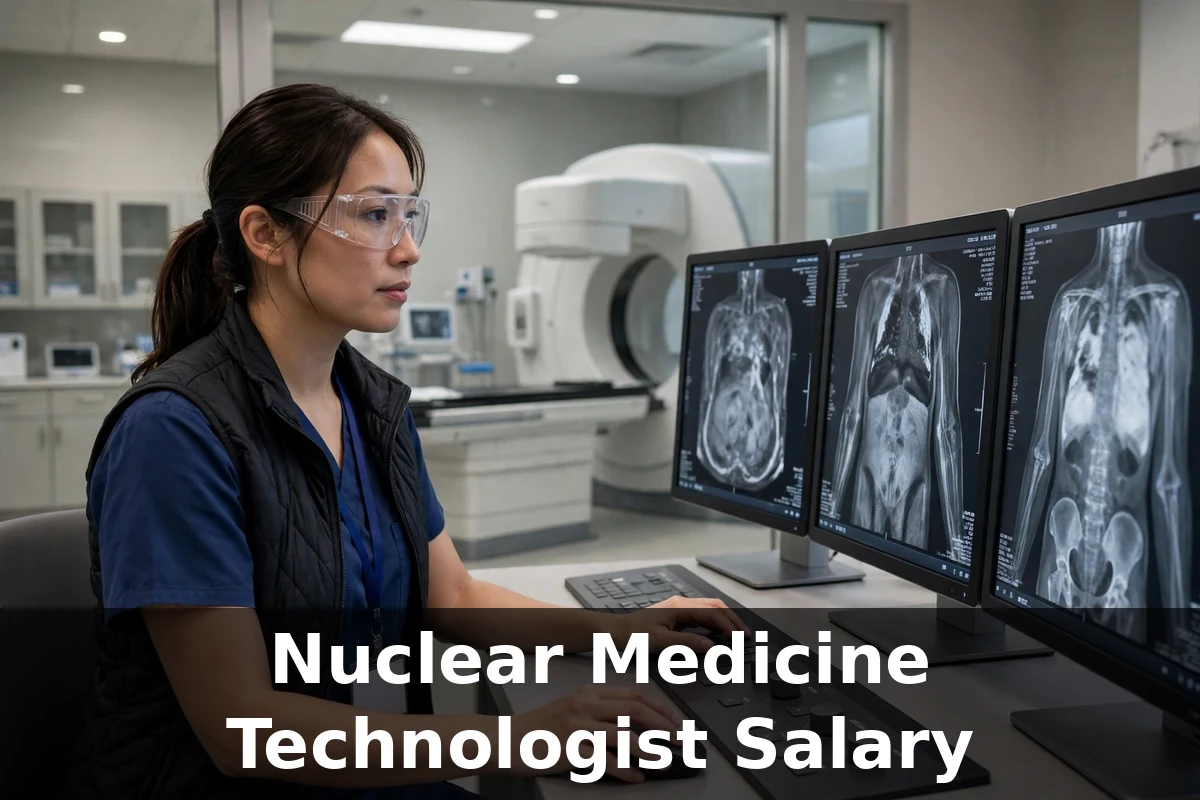
Nuclear Medicine Technologist Salary 2026: Pay by Experience, State and Setting
Nuclear medicine is a small, highly specialized corner of healthcare, and its pay reflects that specialization. The nuclear medicine technologist salary picture in the United States in 2026 starts with a national median of $101,370 a year, or $48.74 an hour, according to the Bureau of Labor Statistics Occupational Employment and Wage Statistics for May 2025, the latest release available.
That median sits well above the national median for all occupations, which the BLS puts at $69,770 a year. The mean, or average, for this occupation is $105,160 a year, and about 17,080 technologists work in the field nationwide. The lowest paid tenth earns less than $78,080 a year, while the highest paid tenth earns more than $134,500, so there is plenty of room to grow within the role.
Nuclear Medicine Technologist Salary: Quick Answer
Most technologists earn between roughly $87,000 and $117,000 a year, which is the middle half of the BLS distribution. New graduates usually start near the lower end of that band, while experienced technologists with PET or CT specialization, or those working in high-cost states, can move well past $120,000. Pay varies by employer, experience, location, certification, and work setting, so treat every figure here as a benchmark, not a promise.
| Pay level | Hourly pay | Annual pay | Approximate monthly equivalent |
|---|---|---|---|
| Lowest 10 percent | $37.54 | $78,080 | $6,507 |
| 25th percentile | $41.69 | $86,720 | $7,227 |
| Median (50th percentile) | $48.74 | $101,370 | $8,448 |
| 75th percentile | $56.31 | $117,120 | $9,760 |
| Highest 10 percent | $64.66 | $134,500 | $11,208 |
| Mean (average) | $50.56 | $105,160 | $8,763 |
Source: U.S. Bureau of Labor Statistics, Occupational Employment and Wage Statistics, May 2025, for nuclear medicine technologists (SOC 29-2033). Monthly figures are annual pay divided by 12 and are labelled approximate monthly equivalents, not guaranteed take-home pay.
Nuclear Medicine Technologist Pay Per Month
When people search for the nuclear medicine technologist salary per month, they usually want a take-home number, but the monthly figures you see online are almost always gross pay before deductions. The median of $101,370 a year works out to an approximate monthly equivalent of $8,448 before tax. A technologist at the 75th percentile would see about $9,760 a month on the same basis, while someone at the 25th percentile would see about $7,227.
Actual take-home pay is lower after federal and state income tax, Social Security and Medicare, and any health insurance or retirement contributions. Shift differentials can raise monthly pay noticeably, since night, weekend, and on-call shifts often carry percentage premiums, but those premiums depend on the employer and are not guaranteed every month.
Pay by Experience Level
The Bureau of Labor Statistics does not publish pay broken down by years of experience, so the table below uses its percentile figures as a rough guide to career stages. Treat it as an approximation, not an official experience scale.
| Career stage | Guidepost figure | Annual pay |
|---|---|---|
| Entry level (first 1 to 2 years) | Near the 25th percentile | Around $86,720 |
| Mid-career (3 to 7 years) | Near the median | Around $101,370 |
| Experienced (8 years or more) | Near the 75th percentile | Around $117,120 |
| Top earners and specialists | Above the 90th percentile | Above $134,500 |
Early-career pay rises fastest when a technologist adds a second skill. PET and CT credentials, cardiac imaging experience, and the ability to run a full range of procedures make a technologist useful on more shifts, and that flexibility is what employers pay extra for. Senior technologists may also take on quality control, protocol development, and training of students, which can come with higher pay or a lead role.
Pay by State
Location creates one of the widest pay gaps in this field. The nuclear medicine technologist salary gap between states runs into tens of thousands of dollars a year, driven by cost of living, hospital concentration, and how many trained technologists are available locally.
| State or district | Median annual pay |
|---|---|
| California | $155,220 |
| Hawaii | $124,380 |
| District of Columbia | $114,750 |
| New Jersey | $111,000 |
| Oregon | $110,600 |
| New York | $109,020 |
Source: BLS-based state compilation of median wages for nuclear medicine technologists. State-level estimates vary between sources and survey releases, and one BLS-based compilation put the California median higher than the figure shown here, so treat state figures as approximate medians rather than exact offers. High pay in California and Hawaii comes with high housing costs, so compare local living costs alongside the salary before deciding a move is worth it.
Pay by Work Setting
Where you work matters almost as much as where you live. The BLS reports median annual wages by industry for May 2025, and the differences are striking.
| Work setting | Median annual pay |
|---|---|
| Outpatient care centers | $171,170 |
| Medical and diagnostic laboratories | $103,410 |
| Hospitals, state, local, and private | $101,280 |
Source: BLS Occupational Employment and Wage Statistics, May 2025, median wages by industry. Hospitals employ about 61 percent of technologists, so the hospital figure is the most representative for a typical job. Outpatient centers show a much higher median, but they employ a smaller, more specialized group, and that figure should not be read as typical pay for the whole occupation.
What Affects Nuclear Medicine Pay
Certification is the first pay factor. The two national credentials are the CNMT from the Nuclear Medicine Technology Certification Board (NMTCB) and the RT(N) credential from the American Registry of Radiologic Technologists (ARRT). Most employers require one of them, and holding an advanced credential in PET or nuclear cardiology can open higher-paying specialist roles.
Licensing is separate from certification and is handled state by state. Around 30 states require technologists to be licensed, and most of those accept national certification in place of a separate state exam, but the rules differ, so check the state where you plan to work. Shift patterns matter too. Night, weekend, and on-call work commonly carries a differential, and technologists willing to cover those shifts often earn more than colleagues on a straight weekday schedule. Finally, metro areas with large academic medical centers tend to pay more than smaller markets, though competition for those jobs is stronger.
What Does a Nuclear Medicine Technologist Do?
Nuclear medicine technologists prepare and administer small amounts of radioactive drugs, called radiopharmaceuticals, and then operate imaging equipment that tracks how those drugs move through the body. The images help physicians diagnose and treat conditions affecting organs such as the heart, bones, thyroid, and brain, and they are also used to plan some cancer treatments.
The work combines patient care, physics, and safety. Technologists explain procedures to patients, position them correctly, operate gamma cameras and PET scanners, check image quality, and follow strict radiation safety rules for handling materials, monitoring exposure, and disposing of waste. They work closely with nuclear medicine physicians, radiologists, nurses, and physicists, and they keep detailed records of doses and procedures.
How to Become a Nuclear Medicine Technologist
The usual route starts with an associate or bachelor’s degree in nuclear medicine technology from an accredited program. About two-thirds of technologists hold an associate degree and about one-fifth hold a bachelor’s, according to O*NET data. Programs include classroom study in anatomy, physics, radiation safety, and imaging, plus supervised clinical training in a hospital or imaging center.
After graduating, candidates sit for a national exam from the NMTCB or the ARRT. The NMTCB accepts graduates of certificate programs as well as degree programs, while the ARRT requires an associate degree or higher for those who completed their professional education on or after January 1, 2015. Once certified, technologists apply for a state license where one is required. If you are comparing healthcare training routes, our phlebotomist salary guide covers a shorter path into laboratory work, though it pays considerably less than nuclear medicine.
Benefits and Shift Differentials
Most hospital and imaging-center jobs come with health insurance, paid time off, and a retirement plan, often a 403(b) in nonprofit hospitals or a 401(k) elsewhere. Employers commonly reimburse certification exam fees and continuing education, and some cover professional membership dues and dosimetry monitoring.
Shift differentials are a real part of total compensation in this field. Night shifts commonly carry a premium of around 15 to 20 percent, and weekend shifts around 10 percent, according to industry salary guides, though exact rates vary by employer. Annual merit increases of a few percent are typical for staff roles. Add those elements together, and total compensation can run noticeably above the base salary figure alone.
Career Growth and Job Outlook
Employment of nuclear medicine technologists is projected to grow about 4 percent from 2025 to 2035, about as fast as the average for all occupations, according to the BLS. Growth is driven by an aging population, wider use of nuclear imaging in diagnosis, and the need to replace technologists who retire or move into other roles.
Career paths run from staff technologist to senior or lead technologist, supervisor, chief technologist, and department manager. Specialists in PET and CT, cardiac imaging, or radiation safety can command higher pay, and some technologists move into applications specialist or sales roles with equipment manufacturers, or into teaching in accredited programs. Because the field is small, reputation and specialization carry real weight, and a strong record in one imaging center often leads to the next opportunity.
Frequently Asked Questions
How much does a nuclear medicine technologist make per month?
The median works out to an approximate monthly equivalent of $8,448 before tax, based on the BLS May 2025 median of $101,370 a year. Actual take-home pay is lower after tax and deductions, and shift differentials can raise it.
What is the starting pay for a nuclear medicine technologist?
New graduates generally start near the 25th percentile, around $86,720 a year, though starting pay varies by state and employer. Some job-market guides report lower starting figures, but the BLS distribution is the more reliable benchmark.
What is the average pay in this field?
The average nuclear medicine technologist salary is $105,160 a year, while the median is $101,370. The average sits above the median because high earners pull it upward, so the median is the better guide to typical pay.
Which state pays the most?
California has the highest median in the state compilation used here, at $155,220 a year, followed by Hawaii at $124,380. Pay in large California metros such as San Francisco and San Jose runs higher still, but so do living costs.
What qualifications do you need?
An associate or bachelor’s degree in nuclear medicine technology from an accredited program, plus national certification from the NMTCB or the ARRT. Around 30 states also require a state license.
Is nuclear medicine technology a good career?
It offers strong pay for a two- to four-year training path, stable hospital employment, and a clear route into specialization. The tradeoffs are radiation safety discipline, shift work, and a small job market, which means relocation may be needed for the best roles.
Do technologists work nights and weekends?
Many do, since hospitals run imaging around the clock and some procedures need early-morning preparation. Night and weekend shifts usually carry pay differentials, which is one reason two technologists with the same base rate can take home different amounts.
How long does it take to become a nuclear medicine technologist?
Typically two years for an associate degree or four years for a bachelor’s, including clinical training. Certificate programs exist for people who already hold a related healthcare credential, and those can be shorter.
Conclusion
Nuclear medicine technology pays well by healthcare standards, with a national median above $100,000 a year and a clear path to higher earnings through specialization, certification, and location. The figures that matter most for your own decision are the median for your state, the pay in your chosen work setting, and the shift pattern you are willing to take. If you are entering the field, pick an accredited program, plan for national certification, and check the licensing rules in the state where you want to work. Those steps put you in the strongest position for both hiring and pay.