
Paramedic Salary 2026: Average Pay, Hourly Rates & Top-Paying States
A paramedic in the United States earns a median salary of roughly $58,000 a year in 2026, or about $28 an hour, according to the latest figures from the Bureau of Labor Statistics and job aggregators. That is the middle of a wide range. Entry-level paramedics at private ambulance companies can start near $40,000, while experienced medics on unionized municipal or fire-based services in high-paying states clear $80,000 or more, and top earners push past six figures when overtime and special duty pay pile up. The numbers below break down what paramedics actually make, by state, employer, certification level, and specialty.
Paramedic Salary 2026: Quick Answer
If you want the short version, here it is. The national median paramedic salary in 2026 sits between $53,000 and $60,000 a year depending on the data source, with ZipRecruiter reporting an average of $54,832 ($26.36 an hour) as of October 2026 and the BLS median at $53,180 for the most recent published year. The typical full-time range runs from about $44,000 at the 25th percentile to $61,000 at the 75th percentile, and the top 10 percent of paramedics make over $79,000 a year.
- National median pay (2026): about $53,000 to $58,000 per year ($26 to $28 per hour).
- ZipRecruiter average, October 2026: $54,832 per year, or $26.36 per hour.
- Entry level (10th percentile): around $40,000 per year.
- Top earners (90th percentile): around $80,000 per year or more, before overtime.
- Highest paying state: Washington, averaging around $94,000 per year (BLS mean).
- Biggest pay jump: moving from EMT to paramedic adds roughly $17,000 a year to the median, about a 41 percent raise.
Paramedic pay depends heavily on where you work and who signs the checks. Fire departments and local government EMS agencies pay the most on average, hospitals sit in the middle, and private interfacility transport companies pay the least. The rest of this guide walks through each of these pieces.
Paramedic Salary Table 2026
| Detail | Figure (2026) |
|---|---|
| National median annual pay | $53,180 to $58,410 (BLS / 2026 salary guides) |
| National median hourly pay | $25.57 to $28.08 per hour |
| National mean (average) annual pay | $54,832 (ZipRecruiter, Oct 2026); $57,450 (BLS) |
| 25th percentile | About $44,000 per year |
| 75th percentile | About $61,000 per year |
| 10th percentile (entry level) | About $40,000 per year |
| 90th percentile (experienced, unionized) | About $79,000 to $82,000 per year |
| Average weekly pay | $1,054 per week (ZipRecruiter) |
| Average monthly pay | $4,569 per month (ZipRecruiter) |
| Projected job growth (2023-33) | 6 percent, faster than average, about 19,000 openings per year |
Sources: U.S. Bureau of Labor Statistics, Occupational Employment and Wage Statistics for Paramedics (SOC 29-2043); ZipRecruiter paramedic salary data, October 2026. BLS figures are the most recently published survey year and reflect verified government data; aggregator averages move with live job postings.
How Much Does a Paramedic Make Per Hour?
The median paramedic earns about $25.57 to $28 an hour depending on the source, but hourly pay matters more in EMS than in most careers because of how shifts work. Paramedics rarely work a standard 40-hour week. The 24-hour shift is still the backbone of fire-based EMS, and private ambulance crews commonly run 12-hour shifts with frequent overtime.
That overtime is where many paramedics make their real money. Overtime is typically paid at 1.5 times the base rate, and in a profession with chronic staffing shortages, voluntary and mandatory overtime is often available in large amounts. A medic with a $27-an-hour base rate who picks up one extra 12-hour shift a week at time-and-a-half earns roughly $486 extra per week, which adds more than $25,000 a year before taxes. This is why two paramedics with identical base salaries can have wildly different actual earnings: one works straight 40-hour weeks, the other stacks overtime.
Night and weekend differentials add more. Many services pay a shift differential of $1 to $3 extra per hour for nights, weekends, and holidays. Hazard pay shows up in some contracts, particularly for tactical medics attached to law enforcement teams. Add everything up and a disciplined paramedic with a solid base rate can comfortably out-earn their official salary band by 20 to 30 percent.
EMT vs Paramedic Pay: The $17,000 Gap
The most important salary fact in EMS is the gap between EMT and paramedic. An EMT-Basic earns a national median of about $41,340 a year, while a paramedic earns a median of about $58,410. That is a difference of more than $17,000 a year, or roughly a 41 percent raise, for the same workplace, the same uniform, and often the same partner on the same rig.
The pay gap exists because the scope of practice is genuinely different. EMTs provide basic life support: CPR, bleeding control, oxygen, splinting, and patient transport. Paramedics provide advanced life support: IV therapy, medication administration, cardiac monitoring, ECG interpretation, intubation, and defibrillation. That expanded scope comes with expanded training, roughly 120 to 150 hours for EMT-Basic versus 1,200 to 1,800 hours and one to two years for paramedic school, plus national certification exams. If you are at the EMT level and weighing paramedic school, the salary math is about as clear as it gets in this field. Our phlebotomist salary guide covers another entry-level healthcare path for comparison if you are still choosing a direction.
Paramedic Salary by Employer Type
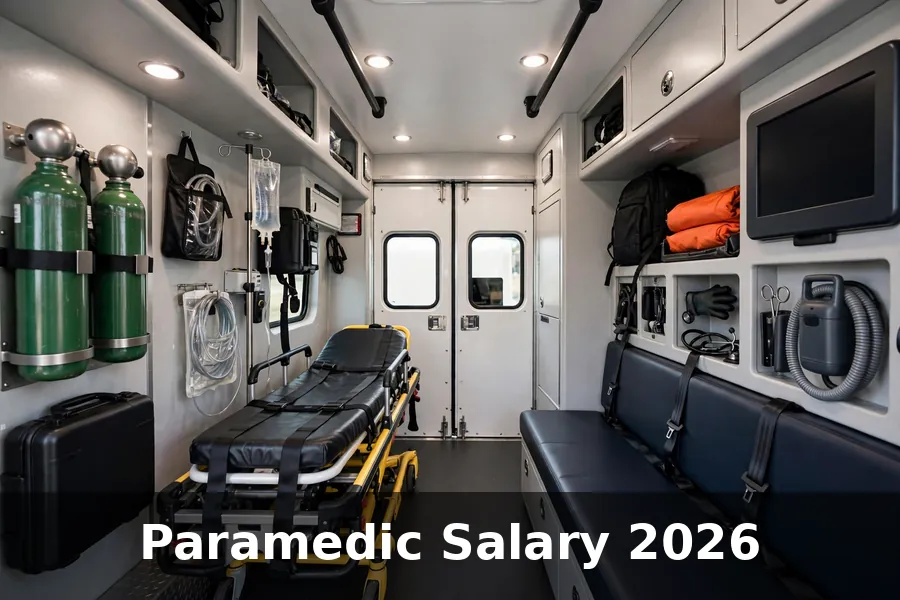
Who you work for matters almost as much as where. The BLS breaks paramedic employment into industry types, and the pay ranking is consistent year after year:
| Employer type | Average annual pay (BLS) |
|---|---|
| Local government EMS / fire departments | $60,300 |
| Hospitals (general medical and surgical) | $56,900 |
| Private ambulance services (ambulatory health care) | $55,200 |
| Physician offices | $55,950 |
| Outpatient care centers | $55,660 |
Fire-department-based EMS pays the most, and it is not close. A paramedic-firefighter in a unionized municipal department typically earns more than the base paramedic salary suggests, because the pay scale includes step increases, longevity bonuses, pension plans that are rare in the private sector, and excellent health coverage. The catch is competition: these jobs are the most coveted in EMS, with hundreds of applicants for a handful of openings in major cities.
Private ambulance companies employ the largest number of paramedics, about 39,000 by the BLS count, and pay near the industry average. Most of the work is interfacility transport rather than 911 response, which means fewer emergencies but steadier, more predictable schedules. Hospitals pay slightly more on average and offer the advantage of working inside a larger healthcare system with clinical ladder options.
Top-Paying States for Paramedics 2026
Geography is the second biggest driver of paramedic pay after certification level. The West Coast and Northeast dominate the top of the list, driven by high costs of living, strong unions, and state labor laws. Here are the top-paying states by mean annual wage for paramedics:
| State | Mean annual pay (BLS) | Mean hourly pay (BLS) |
|---|---|---|
| Washington | $94,500 | $45.43 |
| New Jersey | $80,510 | $38.71 |
| Hawaii | $73,770 | $35.47 |
| District of Columbia | $71,710 | $34.47 |
| Connecticut | $70,350 | $33.82 |
| California | $69,870 | $33.59 |
| New York | $64,890 | $31.20 |
| Maryland | $59,520 | $28.62 |
| Florida | $56,320 | $27.08 |
| Texas | $54,770 | $26.33 |
Washington is in a league of its own. The state’s combination of unionized fire-based EMS, Seattle-area tech money pushing up wages across the board, and strong labor protections produces a mean pay nearly double the national median, and top earners in the state can clear $130,000 a year. New Jersey, Hawaii, and Connecticut follow the same pattern of high costs plus union density.
One honest warning before anyone moves across the country for a paycheck: a $69,000 salary in California does not buy what it sounds like. California has no special EMS magic; it has expensive housing. When you adjust for cost of living, a paramedic making $50,000 in a low-cost state can end up with more money in savings than one making $60,000 on the coast. Look at the real estate before you look at the pay scale.
Lowest-Paying States for Paramedics
At the other end of the table sit rural Southern and Midwestern states. Mississippi, West Virginia, Alabama, and Oklahoma consistently report median paramedic wages between $40,000 and $45,000. West Virginia has the highest concentration of paramedic jobs per capita in the country but one of the lowest pay scales, around $45,280 mean.
Those lower numbers reflect rural Southern and Midwestern markets, where lower housing costs and often solid fire-service benefits partly offset the wage gap. Anyone planning an EMS career should still know the same license pays very differently on either side of a state line.
Highest-Paying Cities for Paramedics
Metro areas tell the same story with sharper detail. The New York City metro employs the most paramedics in the country (over 4,000) and pays a mean of about $65,490 a year. Chicago follows at around $63,180. San Francisco, Boston, and Philadelphia all sit in the $59,000 to $60,000 range.
Within any state, the city-to-rural gap can be $10,000 or more a year. Rural 911 services, often run by volunteer or combination departments, sometimes pay near the entry-level floor. Urban fire departments and hospital-based services pay at the top. If you are flexible on location, targeting a metro area in a high-paying state is the single fastest way to raise your salary without extra school.
Specialty Paramedic Roles That Pay More
For paramedics who want to earn above the median without leaving the field, specialization is the lever. Several niche roles pay premiums:
- Flight paramedic: air medical crews earn some of the highest wages in EMS, often $70,000 to $100,000 or more, but require years of 911 experience, critical care certifications, and a spotless flight record. Openings are scarce.
- Critical care paramedic (CCP): certified to manage ventilators, balloon pumps, and complex drips during interfacility transports. Typically pays 10 to 20 percent above standard paramedic rates.
- Tactical paramedic (TEMSP): medics attached to SWAT and law enforcement teams. Pay varies widely but usually exceeds base paramedic scale, plus hazard differentials.
- Paramedic supervisor / operations manager: the management track. Field supervisors earn $65,000 to $80,000 in most markets, and operations managers more.
- Community paramedic: a growing field focused on home visits and reducing hospital readmissions, with pay generally at or above the local median.
Advanced certifications such as ACLS, PALS, and the critical care endorsement raise earning power in most systems, and many fire departments add 2 to 5 percent pay bumps per degree level.
How to Become a Paramedic: Training, Cost, and Certification
The path to a paramedic license starts with an EMT-Basic certification, which takes about three to six months. From there, a paramedic program adds one to two years of study, including 1,200 to 1,800 hours of classroom work, skills labs, clinical rotations in hospitals, and field internships on ambulances.
Most programs require an associate’s degree or equivalent, and graduates must pass the National Registry of Emergency Medical Technicians (NREMT) paramedic exam, which includes both a computer-based cognitive test and a psychomotor skills exam. After NREMT certification, each state issues its own license or certification, and most states accept NREMT as the basis for licensure.
Program costs vary widely, from a few thousand dollars at a community college to over $15,000 at private schools. The ROI is strong: the roughly $17,000-a-year pay jump over EMT means most paramedics earn back the cost of schooling within the first year or two of working.
Job Outlook for Paramedics 2026
The employment outlook for paramedics is solid. The Bureau of Labor Statistics projects about 6 percent employment growth for EMTs and paramedics from 2023 to 2033, faster than the average for all occupations, with roughly 19,000 job openings each year as workers retire or move into other healthcare roles. An aging population that needs more emergency care and the continued expansion of hospital systems keep demand steady.
Staffing shortages have been a feature of EMS for years, which is both good and bad news for paramedics. The good news is that finding work is rarely difficult, especially for licensed paramedics willing to relocate or work in busy 911 systems. The bad news is that shortages drive the long hours and overtime that define the career. Burnout is the industry’s real enemy, and it is worth factoring into any career plan: the money is there, but the job asks a lot in return.
Paramedic Salary FAQs
What is the average paramedic salary in the US in 2026?
The average paramedic salary in the United States in 2026 is about $54,800 a year according to ZipRecruiter’s October 2026 data, while the BLS median sits at $53,180 to $58,410 depending on the survey year. Most paramedics earn between $44,000 and $61,000, the 25th to 75th percentile range.
How much do paramedics make per hour?
Paramedics earn a median of about $25.57 to $28 an hour. With overtime at time-and-a-half and shift differentials for nights and weekends, effective hourly earnings are often higher than the base rate suggests.
What state pays paramedics the most?
Washington pays paramedics the most, with a mean annual wage of about $94,500 and a median around $104,000 in the most recent data. New Jersey ($80,510), Hawaii ($73,770), and Connecticut ($70,350) round out the top-paying states.
Do paramedics get overtime?
Yes. Paramedics are generally non-exempt hourly employees, so hours over 40 per week (or over the threshold in fire-department schedules) are paid at 1.5 times the base rate. Overtime is plentiful in most systems and can add $15,000 to $25,000 or more to annual earnings.
Is being a paramedic worth it financially?
Compared with EMT-Basic, absolutely: the median paramedic earns about 41 percent more, roughly $17,000 extra per year. Compared with nursing or other healthcare careers, the pay is modest for the responsibility involved, which is why many paramedics eventually bridge into nursing, physician assistant programs, or EMS management.
How long does it take to become a paramedic?
About one to two years of paramedic school after earning an EMT-Basic certification, which takes three to six months on its own. Total training is 1,200 to 1,800 hours, followed by the NREMT paramedic exam and state licensure.
The Bottom Line
Paramedic pay in 2026 is a story of contrasts. The national median of roughly $53,000 to $58,000 a year puts the profession in the middle of the American wage ladder, but the real number depends on three choices you control: your certification level, your state, and your employer. Get the paramedic license instead of stopping at EMT, land a fire-department or municipal job in a high-paying state, and work the overtime that is almost always available, and six figures is genuinely in reach. Stay in private interfacility transport in a low-paying state and work straight 40-hour weeks, and you will earn close to the median and feel every hour of it.
For anyone on the fence about paramedic school, the salary data makes the case by itself. A $17,000-a-year median raise over EMT-Basic pays for the training many times over, and the demand side of the equation, 19,000 openings a year and 6 percent growth, means the jobs will be there when you finish. Just go in with open eyes about the cost of living in high-paying states and the overtime culture that turns a base salary into a real income.