
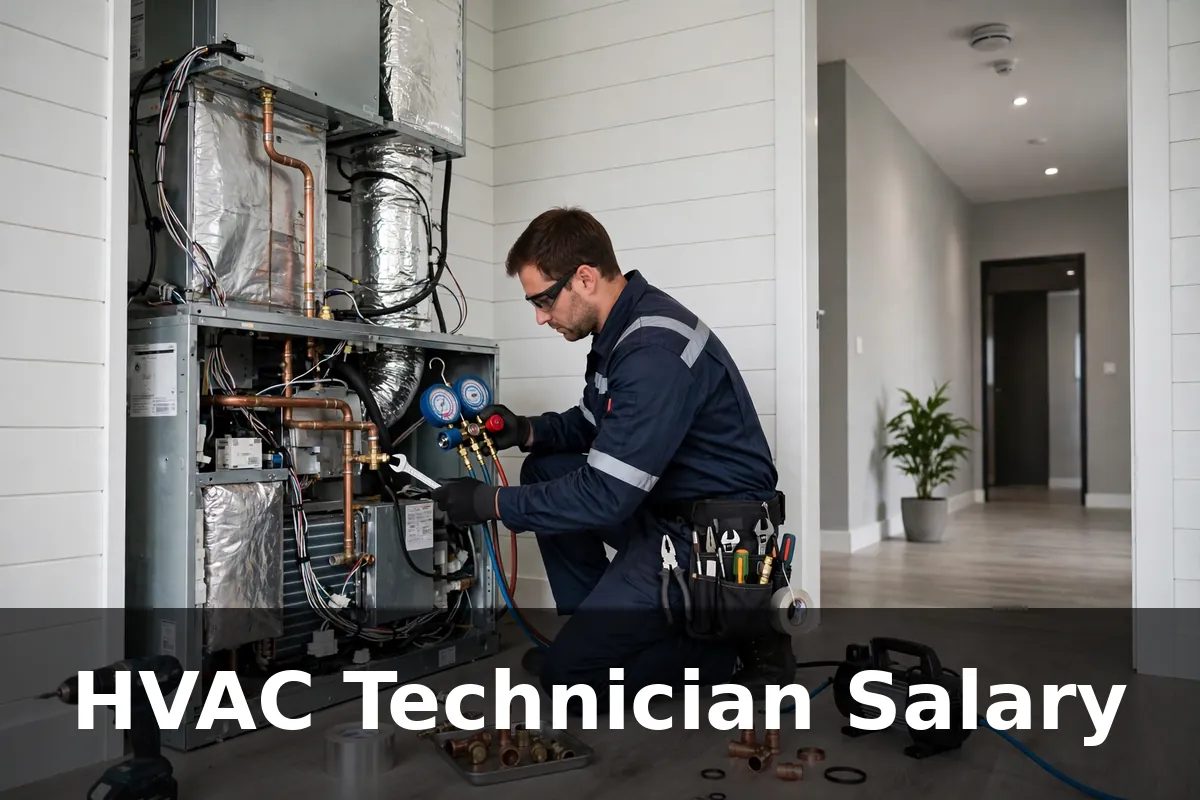
HVAC Technician Salary 2026: Hourly Pay, Annual Income and Top States
Heating and cooling work keeps homes, hospitals, schools, and factories running, and the pay reflects how essential that work is. The hvac technician salary picture in the United States in 2026 centers on a national median of $61,010 a year, or $29.33 an hour, according to the Bureau of Labor Statistics Occupational Employment and Wage Statistics for May 2025, the latest release available.
That median is only the middle of a wide range. The lowest paid tenth of technicians earned less than $40,050 a year, while the highest paid tenth earned more than $95,210. Where you live, how many years you have in the trade, and whether you hold extra certifications all move your pay well above or below that middle figure.
HVAC Technician Salary: Quick Answer
Most technicians who are past the apprentice stage land somewhere between $50,000 and $75,000 a year, with experienced commercial and union technicians pushing past $90,000. Apprentices start lower, and overtime, on-call premiums, and commissions can add a meaningful amount on top of base hourly pay. Pay varies by employer, experience, location, qualifications, and compensation structure, so treat every figure here as a benchmark, not a promise.
| Pay level | Hourly pay | Annual pay | Approximate monthly equivalent |
|---|---|---|---|
| Lowest 10 percent | $19.25 | $40,050 | $3,338 |
| Median (50th percentile) | $29.33 | $61,010 | $5,084 |
| Mean (average) | $31.14 | $64,780 | $5,398 |
| Highest 10 percent | $45.78 | $95,210 | $7,934 |
Source: U.S. Bureau of Labor Statistics, Occupational Employment and Wage Statistics, May 2025, for heating, air conditioning, and refrigeration mechanics and installers (SOC 49-9021), covering about 409,670 wage and salary workers. Monthly figures are annual pay divided by 12 and are labelled approximate monthly equivalents, not guaranteed take-home pay. The survey excludes self-employed technicians, so owner earnings are not part of these figures.
HVAC Technician Pay Per Month
When people look up the hvac technician salary per month, they usually want a take-home number, but the monthly figures you see online are almost always gross pay before deductions. The median of $61,010 a year works out to an approximate monthly equivalent of $5,084 before tax. A technician at the 90th percentile would see roughly $7,934 a month on the same basis, while someone at the 10th percentile would see about $3,338.
Actual take-home pay is lower after federal and state income tax, Social Security and Medicare, and any health insurance or retirement contributions. It is also rarely flat month to month in this trade. Summer and winter bring longer hours and more overtime, while shoulder seasons can be quieter, so a technician paid by the hour may earn noticeably more in July than in April.
Starting Pay for New Technicians
Newcomers usually start as helpers or apprentices, and the pay reflects that. Job-market guides put apprentice pay in the range of $39,000 to $50,000 a year, or roughly $18 to $24 an hour. Apprenticeships typically combine paid on-the-job training with classroom instruction, and pay rises in steps as the apprentice completes each stage.
One credential matters from the start. Technicians who work with refrigerants must hold EPA Section 608 certification under federal rules, and most employers expect it before a new hire works unsupervised. A postsecondary certificate or diploma from a trade school can shorten the path to a full technician role, but it does not replace hands-on experience, which is what moves pay upward fastest in the first few years.
Pay by Experience Level
The Bureau of Labor Statistics does not publish pay broken down by years of experience, so the table below combines its percentile figures with ranges reported by trade salary guides. Treat the experience rows as reported market ranges rather than official statistics.
| Experience level | Typical annual range | Typical hourly range |
|---|---|---|
| Apprentice or helper (0 to 2 years) | $39,000 to $50,000 | $18 to $24 |
| Journeyman technician (2 to 5 years) | $54,000 to $83,000 | $26 to $40 |
| Senior or lead technician (5 to 10 years) | $75,000 to $95,000 | $36 to $46 |
| Master or commercial specialist (10 years or more) | $85,000 to $120,000 | $41 to $58 |
The jump from journeyman to senior is where pay changes most. Lead technicians run jobs, diagnose the faults that stump newer techs, and mentor apprentices, and employers pay for that reliability. Commercial and industrial refrigeration specialists sit at the top of the range, because the systems are larger, the downtime costs are higher, and fewer technicians have the skills to service them.
Pay by State
Location is the single biggest pay lever in this trade. State figures show why the hvac technician salary varies so much from one part of the country to another, and the pattern is not random. High-cost coastal and northern markets pay more, while lower-cost southern states pay less, and union density in big cities pushes rates up further.
| State or district | Median annual pay | Median hourly pay |
|---|---|---|
| District of Columbia | $84,390 | $40.57 |
| Alaska | $77,430 | $37.23 |
| Illinois | $77,410 | $37.22 |
| Massachusetts | $77,300 | $37.16 |
| Connecticut | $76,610 | $36.83 |
| California | $72,560 | $34.88 |
| Mississippi | $48,680 | $23.40 |
| Alabama | $48,370 | $23.25 |
| Arkansas | $48,110 | $23.13 |
Source: BLS Occupational Employment and Wage Statistics, May 2025, median wages for SOC 49-9021. Note that a higher median does not always mean a better standard of living, since housing and everyday costs in Alaska, California, and the Northeast run well above the national average. Florida has the most technician jobs in the country at about 39,160, followed by California at about 35,130 and Texas at about 34,730, so job availability matters as much as the pay rate when you choose where to work.
What Affects HVAC Pay
Several factors decide whether a technician earns near the bottom or the top of the range. Certification is the first. EPA Section 608 is mandatory for refrigerant work, and NATE certification signals tested competence to employers and customers, which helps in hiring and promotion. Experience is the second, and it compounds, because every year adds systems you have seen before and faults you can diagnose faster.
Employer type matters just as much. Union shops in large metro areas generally pay above non-union rates and offer stronger benefits. Commercial and industrial employers tend to pay more than residential firms, but the work can involve larger systems, night shifts, and stricter safety rules. Specialization is another lever. Technicians who handle commercial refrigeration, building automation controls, or heat pump systems are scarcer, and scarcity pays. Finally, overtime and on-call rotations add real money in peak seasons, though they also mean evenings, weekends, and emergency callouts.
What Does an HVAC Technician Do?
HVAC technicians install, maintain, and repair heating, ventilation, air conditioning, and refrigeration systems in homes, offices, hospitals, schools, and factories. A typical day mixes scheduled maintenance, such as cleaning coils, checking refrigerant levels, and testing controls, with repair calls where a system has stopped working and the fault has to be found fast.
The work is physical and technical at once. Technicians read blueprints and wiring diagrams, use gauges, meters, and leak detectors, and follow safety rules for electrical work, gas lines, and refrigerants. They also deal directly with customers, explaining what failed, what the fix will cost, and how to keep the system running. Good communication matters here, because a customer who understands the repair is far more likely to approve it.
How to Become an HVAC Technician
The usual route starts with a high school diploma or equivalent, with coursework in math, physics, and basic electronics helping a lot. From there, most people either enter a paid apprenticeship, which typically runs several years and combines work with classes, or complete a certificate or associate program at a trade school or community college and then start as a helper or junior technician.
Next comes EPA Section 608 certification, which is required to handle refrigerants. Some states and localities also require a license, so check the rules where you plan to work. NATE certification is voluntary but widely recognized, and many technicians add it after a year or two on the job. From there, the path runs from apprentice to journeyman to lead technician, and then toward supervisor, estimator, service manager, or running your own contracting business.
Benefits, Overtime and On-Call Pay
Most full-time technician jobs come with health insurance, paid time off, and a retirement plan, and larger or union employers usually offer the stronger packages. Company vehicles, uniforms, tools, and paid training are common extras, and they are worth real money even though they never appear in a salary figure.
Overtime is a regular feature of the trade rather than an exception. Time-and-a-half for hours beyond 40 a week is standard for hourly technicians, and emergency or after-hours calls often carry a premium or a minimum callout payment. That is one reason annual earnings for busy technicians can run well above what their base hourly rate alone would suggest, especially in summer heat waves and winter cold snaps.
Career Growth and Job Outlook
Demand for HVAC technicians is strong and expected to stay that way. The Bureau of Labor Statistics projects employment growth faster than the average for all occupations, driven by new construction, replacement of aging systems, growing interest in energy-efficient heat pumps, and expanding commercial refrigeration. Skilled technicians are hard to replace quickly, which gives experienced workers real bargaining power.
Career growth does not stop at senior technician. Common next steps include lead technician, field supervisor, service manager, estimator, system designer, and sales engineer roles, and many experienced technicians eventually start their own shops. Self-employment can pay very well, but it also carries overhead, insurance, licensing, and the risk of slow seasons, so the salary figures in this guide describe employed technicians, not business owners.
Frequently Asked Questions
How much does an HVAC technician make per hour?
The national median is $29.33 an hour, based on BLS May 2025 data. Apprentices typically earn $18 to $24 an hour, mid-career technicians earn roughly $26 to $40, and senior or specialist technicians can earn $46 or more.
What is the starting salary for an HVAC technician?
Apprentices and helpers generally start between $39,000 and $50,000 a year. Pay rises in steps during an apprenticeship and jumps once a technician can work unsupervised and hold EPA Section 608 certification.
Can HVAC technicians make $100,000 a year?
Yes, but it is not typical for a new technician. The top tenth of the occupation earns above $95,210 a year, and senior commercial, union, or specialist technicians with steady overtime can pass $100,000. Reaching that level usually takes years of experience plus a valuable specialization.
Which state pays HVAC technicians the most?
The District of Columbia has the highest median at $84,390 a year. Among states, Alaska leads at $77,430, followed closely by Illinois and Massachusetts. The lowest medians are in Arkansas, Alabama, and Mississippi, all under $49,000.
Does certification raise HVAC pay?
EPA Section 608 certification is required for refrigerant work, so it is a baseline rather than a bonus. NATE certification and manufacturer training can raise pay indirectly by qualifying you for better-paying commercial and specialist roles.
Is HVAC pay hourly or salaried?
Most technicians are paid hourly, which is why overtime matters so much in this trade. Some senior, supervisory, and sales roles are salaried. The median hourly rate of $29.33 works out to an approximate monthly equivalent of $5,084 before tax on a full-time schedule.
Do HVAC technicians get overtime pay?
Yes, overtime is common, especially in peak summer and winter months. Hourly technicians typically earn time-and-a-half beyond 40 hours a week, and after-hours emergency calls often carry extra premiums.
What does an experienced technician earn?
The hvac technician salary for an experienced commercial or lead technician commonly reaches $75,000 to $95,000 a year, with the top tenth of the occupation earning above $95,210. Specialization, union membership, and a high-paying state can push earnings higher still.
Conclusion
HVAC work pays a solid middle-class wage, and it pays better the more skill and responsibility you carry. The national median of $61,010 a year is a fair starting point for 2026, but your actual earnings will depend on your state, your experience, your certifications, and whether you work residential, commercial, or union jobs. If you are entering the trade, focus on finishing an apprenticeship, earning EPA Section 608 certification, and building diagnostic speed. Those three steps do more for long-term earnings than chasing the highest advertised hourly rate in any single job posting.